

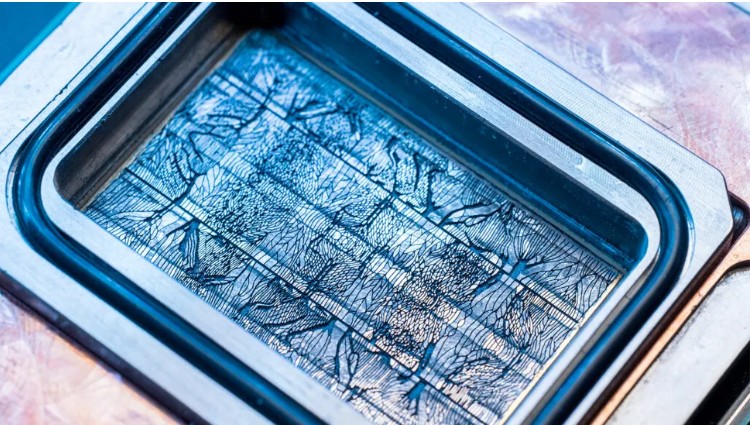
Microsoft has revealed a breakthrough cooling technique that etches microfluidic channels directly into the back of a chip’s silicon die, says Tom’s Hardware. The goal: bring coolant closer to the actual heat sources and dramatically reduce peak temperatures.
Conventional liquid cooling approaches, such as cold plates, cool from outside the chip, meaning heat must travel through multiple layers of materials before touching the coolant. That introduces thermal resistance and limits how hot a chip can get. Microsoft’s approach bypasses much of that by channeling liquid inside the chip itself. In lab tests, this method cut peak silicon temperature rises by up to 65% and outperformed cold-plate cooling by as much as three times.
The design process combined AI and biomimicry. Working with Swiss startup Corintis, Microsoft used AI to optimize channel layouts, sometimes mimicking the branching of leaves or wings, to route coolant efficiently to hotspots. The dimensions and patterns of channels had to strike a balance: deep enough for effective flow, but shallow enough not to weaken the silicon.
Integration into manufacturing is non-trivial. Etching channels adds steps and complexity to chip fabrication. Microsoft also plans to produce microfluidic modules that interface with chips to avoid rewriting entire manufacturing lines. Leak-proof packaging, coolant selection, and process resilience are part of the challenge.
Microsoft has already begun trialing the technology in server environments. For instance, they ran simulated workloads in Teams, where dynamic heat loads stress cooling systems. The microfluidic design lets chips safely handle spikes, potentially enabling more compact and overclockable systems.
If broadly adopted, this approach could reshape how data centers are built. Lower cooling overhead means denser racks, reduced energy costs, and a path toward advanced architectures like 3D-stacked chips, where heat has been a longstanding barrier.
Microsoft’s in-chip microfluidics is a bold leap: instead of treating cooling as an add-on, it makes thermal control part of the silicon itself. If it scales, it could unlock new performance frontiers in AI and data center hardware.
