

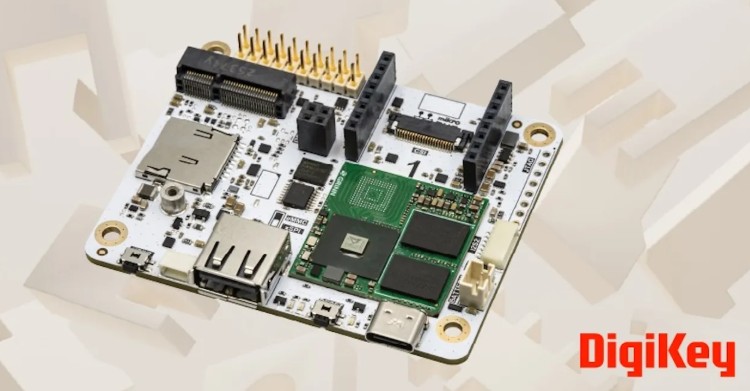
Edge AI is gaining ground as engineers look for ways to process data locally rather than depend on cloud infrastructure. Coralboard, a new development board distributed by DigiKey, is designed to make that transition easier by providing an open, power-efficient platform for developing AI-enabled products, tells Design News.
Running AI directly on devices can reduce latency, bandwidth costs, connectivity risks, and cloud expenses. It also helps keep sensitive audio, video, and biometric information on the device, an important consideration for applications subject to privacy and cybersecurity requirements. These capabilities are particularly relevant for wearables, appliances, industrial equipment, smart cameras, and other systems that need fast, autonomous responses.
At the heart of Coralboard is the Synaptics Astra SL2619 processor, integrated through the Grinn AstraSOM-261x system-on-module. The board also incorporates Coral NPU technology from Google Research for dedicated AI acceleration. Synaptics’ open-source, MLIR-based Torq toolchain supports model development, optimization, and deployment. The platform can run different AI workloads, including hardware-accelerated Gemma 3 270M.
Rather than requiring developers to build AI models and supporting infrastructure from scratch, Coralboard can work with existing models and open-source resources. This approach lets engineers spend more time adapting AI to their specific products and applications.
A key feature is its path from experimentation to commercial deployment. Engineers can begin with the off-the-shelf Coralboard SL for evaluation and proof-of-concept work. They can then move to the Grinn AstraSOM-261x for product integration before transitioning to a custom design based directly on the SL2619 processor for higher-volume production.
Coralboard is also designed for ultra-low-power, always-on applications, including battery-constrained devices using ambient sensing. Plug-and-play support for cameras, displays, and audio, along with Ethernet-over-USB and optional Wi-Fi and Bluetooth connectivity, gives engineers a practical platform for developing responsive, private edge AI products.
