

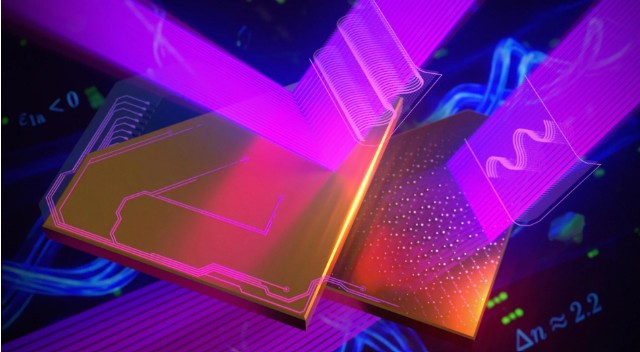
Researchers have identified an unusual crystal with optical properties that could reshape the future of wearable technology. The material, called molybdenum oxychloride (MoOCl₂), displays an extraordinary ability to control light, behaving like a reflective metal in one orientation and a transparent glass in another. Scientists have now produced the first detailed experimental map of its optical characteristics, revealing what they describe as the strongest light-bending effect ever measured in a natural material, tells Science Daily.
The research, conducted by a team from XPANCEO in collaboration with scientists from the National University of Singapore and the University of Chemistry and Technology, Prague, addresses a major challenge in next-generation optics. Emerging technologies such as smart contact lenses and ultrathin augmented reality glasses require optical components that are dramatically smaller than those used today. Conventional lenses and hardware are too bulky for these applications, prompting researchers to explore materials capable of manipulating light at the atomic scale.
A key feature of MoOCl₂ is its extreme optical anisotropy, meaning its behavior changes significantly depending on the direction in which light travels through it. The crystal exhibits an in-plane birefringence value of approximately 2.2, enabling it to split and redirect light with remarkable efficiency. This property could allow optical functions traditionally performed by thick components to be achieved using layers thousands of times thinner than a human hair.
The team also discovered an epsilon-near-zero point at a wavelength of 512 nanometers, corresponding to green light. At this point, light can slow dramatically while remaining strongly confined within the material. Such behavior is highly sought after in photonics because it can enhance light-matter interactions and improve the performance of optical devices.
Published in Nano Letters, the study suggests that MoOCl₂ could become an important building block for future photonic technologies, including compact optical chips, advanced sensors, augmented reality systems, and wearable displays. By combining metal-like and glass-like behavior within a single natural crystal, the material offers a new pathway toward miniaturized devices that can manipulate light with unprecedented precision.
