

Architectural visualization is moving beyond polished images toward interactive environments where project decisions can be discussed and evaluated in real time. As clients, engineers, consultants, and design teams become involved earlier in projects, presentations increasingly serve as working design sessions rather than final showcases, says Arch Daily.
D5 3.1 responds to this shift with Interactive Presentation, which combines the organization of a slide presentation with access to the live project. Architects can arrange viewpoints, design schemes, materials, lighting, weather conditions, and object visibility within a presentation. Instead of preparing new images whenever questions arise, teams can compare alternatives and revisit earlier decisions during the review itself.
Immersive tools expand this approach. Stereoscopic Panorama provides depth-aware VR experiences that improve understanding of scale, materials, and spatial relationships. An updated Spatial Tour offers faster scene generation, smoother movement between interiors and exteriors, and dollhouse views for understanding complex designs. These capabilities supplement rather than replace conventional renderings and animations.
Visualization is also moving earlier into design development. D5 Lite, previously available for SketchUp, now supports Rhino and Revit. Designers can evaluate materials, lighting, façades, massing, and visual direction while concepts are still evolving. Projects requiring more advanced imagery, animation, or interactive reviews can then continue in D5 Render.
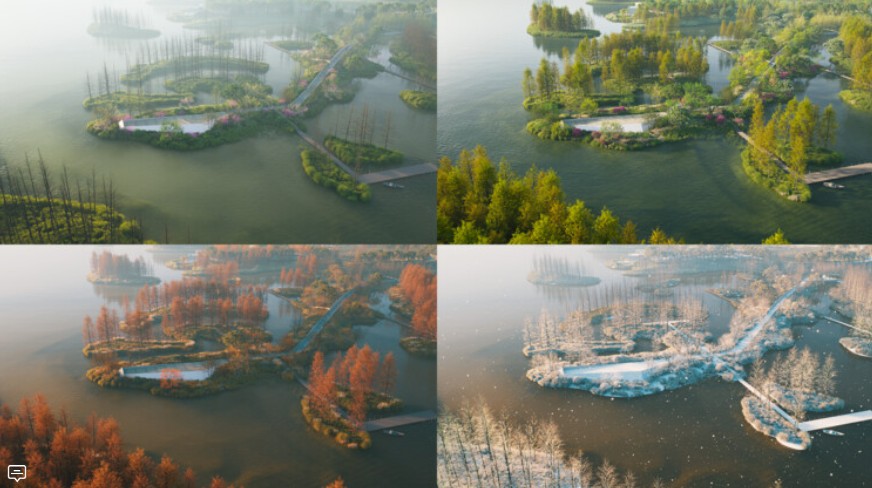
D5 3.1 also improves rendering quality through ACEScg Working Color Space, HeightField Tracing for detailed displacement materials, and Seasonal Vegetation. These improvements help visual quality remain consistent as projects are explored under different conditions.
Together with Cloud Collaboration, these capabilities create a workflow extending from early visualization through final review. The larger change is that visualization becomes a continuous part of architectural development, helping teams keep projects visible, open to discussion, and easier to refine as decisions evolve.
