

Artificial intelligence is transforming architectural design, but unpredictable changes to approved geometry and project requirements remain a concern. Snaptrude introduces deterministic generative design as a controlled approach that allows architects to explore alternatives while preserving established constraints and design decisions.
Unlike conventional generative workflows, deterministic design explicitly defines inputs, permitted variations, system states, and acceptance rules. Repeating a task under identical conditions should reproduce the same result or explain any differences. The objective is not to eliminate creativity but to prevent unintended changes during design exploration.
Snaptrude identifies four control states. Locked elements, such as site boundaries and approved room counts, cannot change. Bounded variables, including story heights and area tolerances, may vary within specified limits. Free variables allow exploration of massing, circulation, and other design alternatives. Proposed changes require human approval before becoming accepted project decisions.
A central component is state memory, which records previous decisions, model conditions, and approved changes. This prevents subsequent AI-generated iterations from silently overriding earlier work.
The approach also emphasizes reproducibility. Architects should preserve source inputs, model revisions, software versions, constraints, and evaluation methods. Generated alternatives must remain editable and comparable through documented changes, performance metrics, and unresolved conflicts.
When conflicting requirements arise, the system should identify the problem and request clarification rather than independently relaxing constraints. Professional review remains essential, particularly when building codes, safety requirements, or contractual obligations are involved.
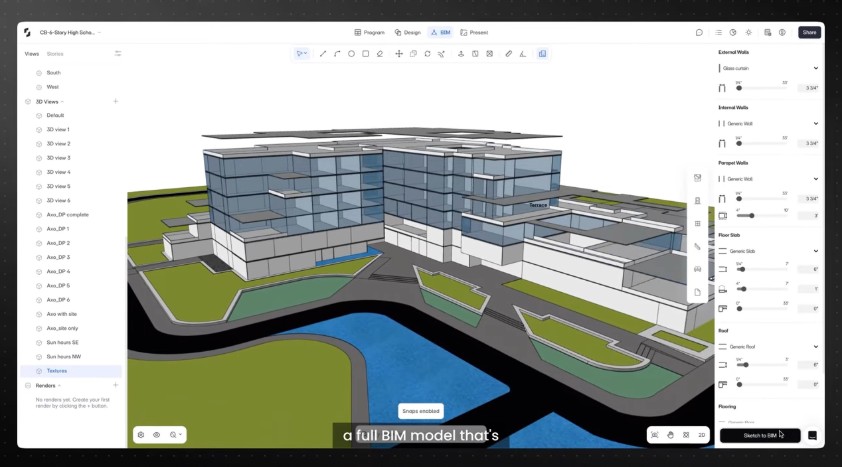
Snaptrude’s connected BIM environment supports AI-assisted site analysis, programming, parametric modeling, documentation, and collaboration. However, the company acknowledges that its existing capabilities do not establish perfect determinism across every generative operation.
For AEC professionals, the framework offers a practical direction for integrating AI into architectural workflows. By combining controlled variation, traceable decisions, and human oversight, deterministic generative design could make AI-generated building concepts more dependable, auditable, and suitable for further development.
