

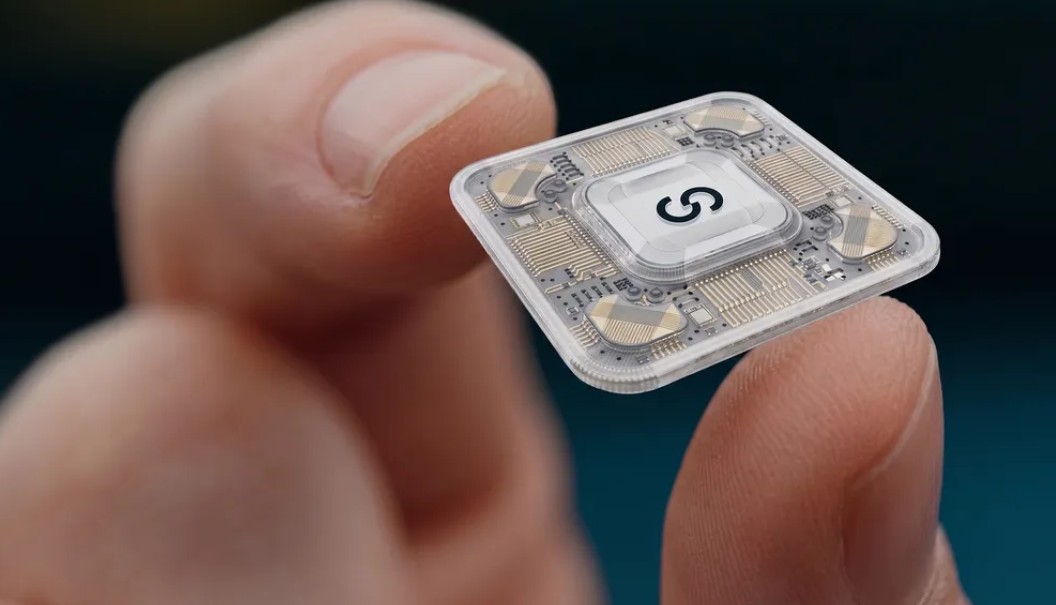
German startup Saxon Q has unveiled what it describes as the world’s first diamond-based quantum computer to exceed 10 qubits, marking a significant advance in room-temperature quantum computing. The system uses nitrogen-vacancy (NV) centers in synthetic diamonds as qubits, allowing quantum operations without the complex cryogenic cooling required by many existing quantum computers. The company currently offers rack-mounted systems with up to 128 qubits and plans to introduce 512-qubit systems next year, with a long-term goal of scaling beyond 10,000 qubits after 2030, tells Live Science.
Nitrogen-vacancy quantum computing is not a new concept, but expanding the technology beyond 10 qubits has proved difficult because of the challenge of reliably creating stable NV centers. Saxon Q overcame this hurdle through a materials innovation that involves co-implanting sulfur atoms when creating nitrogen vacancies in laboratory-grown diamonds. The sulfur helps stabilize the vacancies by supplying electrons, resulting in greater control over individual qubits and a much higher manufacturing yield.
The qubits are initialized with lasers and manipulated using microwave pulses, enabling them to enter quantum states that conventional binary bits cannot achieve. According to Saxon Q, the system initially demonstrated a 99.92% fidelity rate before error correction, while more recent internal testing reached 99.98% fidelity for single-qubit operations. Although these results have not yet been independently verified, they are comparable to leading performance reported by major quantum computing research groups.
Unlike superconducting quantum computers, which require elaborate cooling systems and specialized facilities, Saxon Q’s machines fit into a standard server rack and operate from a conventional alternating-current power supply. This simpler deployment could make them attractive for organizations seeking on-premises quantum computing, particularly in edge computing applications such as autonomous vehicles and robotics where cloud latency can be a limitation.
Despite the breakthrough, scaling remains a challenge. Current chips support only 8 or 16 qubits, meaning future systems will require much denser qubit arrays to achieve the hundreds of thousands or millions of qubits needed for large-scale quantum applications. Even so, the achievement demonstrates that room-temperature quantum computing is progressing from laboratory research toward practical commercial systems.
