

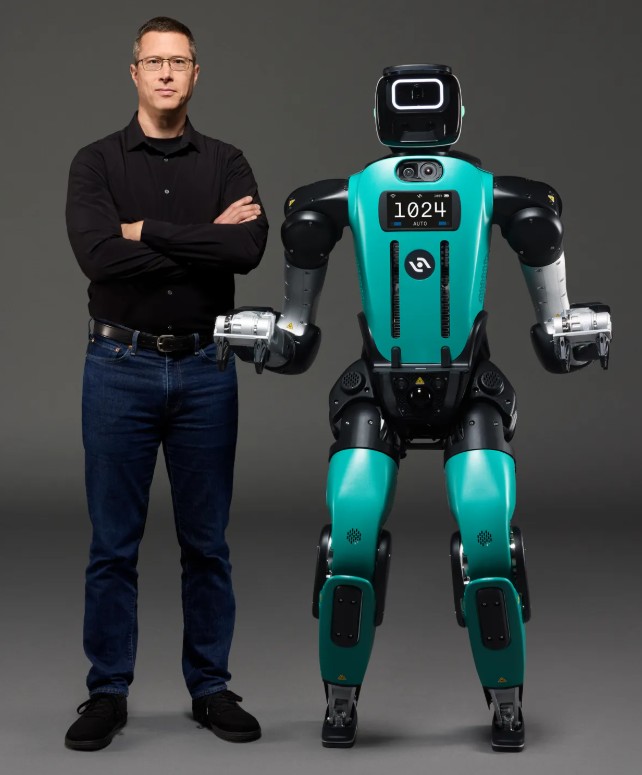
Agility Robotics co-founder Jonathan Hurst describes Digit 5 as a departure from the lightweight, graceful humanoid he originally envisioned. Instead, the company’s latest robot reflects lessons learned from years of commercial testing, where safety, reliability, payload, battery life, and regulatory compliance matter more than elegant movement, tells IEEE Spectrum.
Agility’s journey began with ATRIAS and Cassie, research robots designed around efficient bipedal locomotion. Adding a torso and arms eventually produced Digit, allowing the robot to combine movement with manipulation. Warehouses emerged as a practical market because handling bins requires mobility, balance, and two arms, while conventional automation struggles with varying environments and tasks.
Commercial deployments exposed limitations. Earlier Digit models sometimes required physical barriers separating robots from workers. For Digit 5, Agility spent two years making safe operation around people a central design requirement. Sensors detect nearby workers, and when someone approaches, the robot can stop its task, put down its payload, sit on the floor, and cut motor power.
These safety requirements contributed to a much larger machine. Digit 5 weighs more than 120 kilograms and is engineered to repeatedly lift 23-kilogram bins onto shelves up to 1.75 meters high. Its battery provides about 90 minutes of operation and can recharge in 9 minutes, supporting a target of 20 working hours per day. The battery and cooling system occupy roughly three-quarters of its torso.
Digit 5 also replaces Agility’s distinctive backward-bending legs with a more humanlike configuration. The change improves squatting and helps the robot lift heavy objects from near floor level.
Hurst acknowledges that these decisions sacrifice running, jumping, and visual elegance. Yet they illustrate a larger engineering lesson: commercially successful humanoids must satisfy real jobs, regulations, economics, and safety requirements. Digit 5 therefore represents Agility’s shift from experimental robotics toward a scalable industrial worker and a platform for broader manipulation and manufacturing tasks.
