

Researchers at Pohang University of Science and Technology (POSTECH) in South Korea have developed a drone-assisted tracking technology that accurately measures three-dimensional motion across large outdoor spaces. The system, called Drone-Assisted Multicamera 3D Tracking (DAM3T), uses a flying drone as a moving reference point to simplify camera calibration and improve outdoor motion analysis, says Tech Xplore.
Led by Professor Jin-Tae Kim and master’s student Jungyeon Kim from POSTECH’s Department of Mechanical Engineering, the research addresses a longstanding challenge in 3D motion capture: maintaining measurement accuracy outside controlled laboratory environments.
Conventional multicamera tracking systems require precise knowledge of each camera’s position and orientation. Calibrating these systems across large outdoor areas typically involves installing oversized reference grids or specialized structures, increasing costs, labor, and setup complexity.
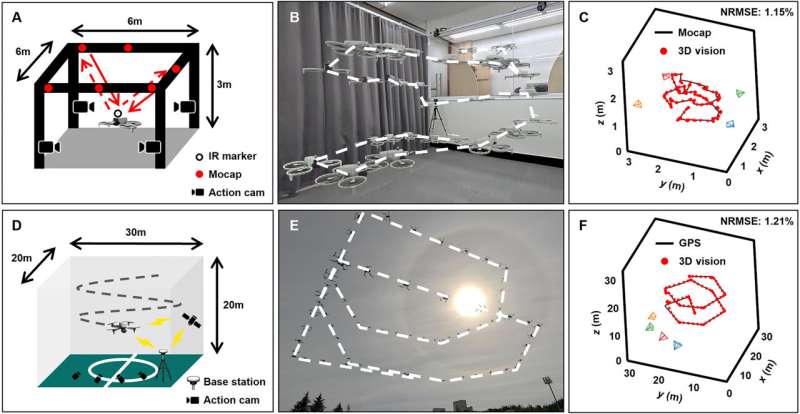
DAM3T eliminates this requirement by using a drone’s flight trajectory as a calibration reference. Multiple cameras simultaneously record the drone’s movement, while a computer algorithm automatically determines their relative positions and orientations.
The system incorporates real-time kinematic GPS (RTK-GPS), which provides centimeter-level positioning accuracy. This enables researchers to translate reconstructed movements into geographic coordinates, including latitude, longitude, and altitude.
Experimental results demonstrated promising accuracy. In a controlled indoor environment measuring 6 × 6 × 3 meters, the system recorded an average error of approximately 2.3 centimeters, equivalent to 1.15%. Outdoor experiments spanning several tens of meters produced an error of 1.21%.
Researchers demonstrated the technology by tracking multiple drones, monitoring airflow using illuminated helium balloons, and reconstructing basketball players’ movements alongside the ball’s three-dimensional trajectory.
Published in the journal Science Advances, the research highlights potential applications in atmospheric monitoring, autonomous drone coordination, aerial vehicle tracking, and sports analytics.
By replacing stationary calibration equipment with a mobile reference, DAM3T could make large-scale outdoor motion measurement more accessible, flexible, and practical for engineering and scientific applications.
