

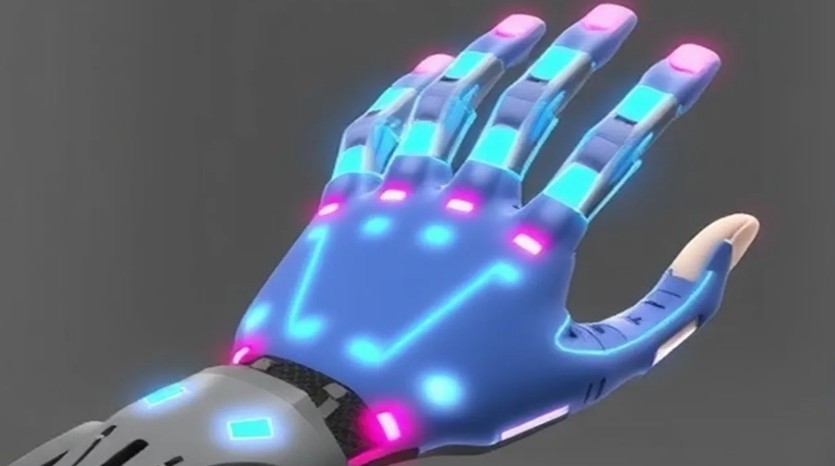
Researchers at Hanyang University in South Korea have developed an electronic sensing technology that could improve the ability of robots, prosthetics, and wearable devices to perceive physical interactions. The vertically integrated, dual-gated tribotronic transistor addresses two limitations of conventional tribotronic sensors: fixed sensitivity and difficulty integrating large numbers of sensors into compact arrays, tells Design News.
Tribotronic devices convert mechanical stimuli into electrical signals through the redistribution of electric charges. Although useful for electronic skin and robotics, existing designs can be difficult to scale. The Hanyang University team instead created a vertical architecture that reduces each sensor’s footprint while allowing its sensitivity to be electrically adjusted.
The device combines a polydimethylsiloxane triboelectric sensing layer, which serves as the top gate, with a gate insulator and an indium-tin-zinc-oxide thin-film transistor. When an object contacts the sensing surface, triboelectric charges form. As the object moves away or approaches again, the resulting electrical potential changes the transistor current, enabling the sensor to detect both contact and proximity. Adjusting the bottom-gate voltage changes the baseline current and therefore the sensor’s sensitivity.
Tests also showed that greater contact pressure produces more triboelectric charge and a stronger electrical response. The device recorded response and recovery times of 127 and 212 milliseconds, respectively, and maintained stable performance after 1,000 operating cycles.
To demonstrate scalability, the researchers fabricated a 10-by-10 transistor array. Individual pixels successfully detected finger touches and sensed a stainless-steel probe approaching from distances of up to 500 micrometers.
The technology could ultimately support electronic skin capable of distinguishing touch, pressure, and nearby objects with greater precision. Such capabilities may improve human-machine interaction in healthcare robots, prosthetic devices, health-monitoring wearables, and autonomous systems where reliable physical sensing is essential.
