

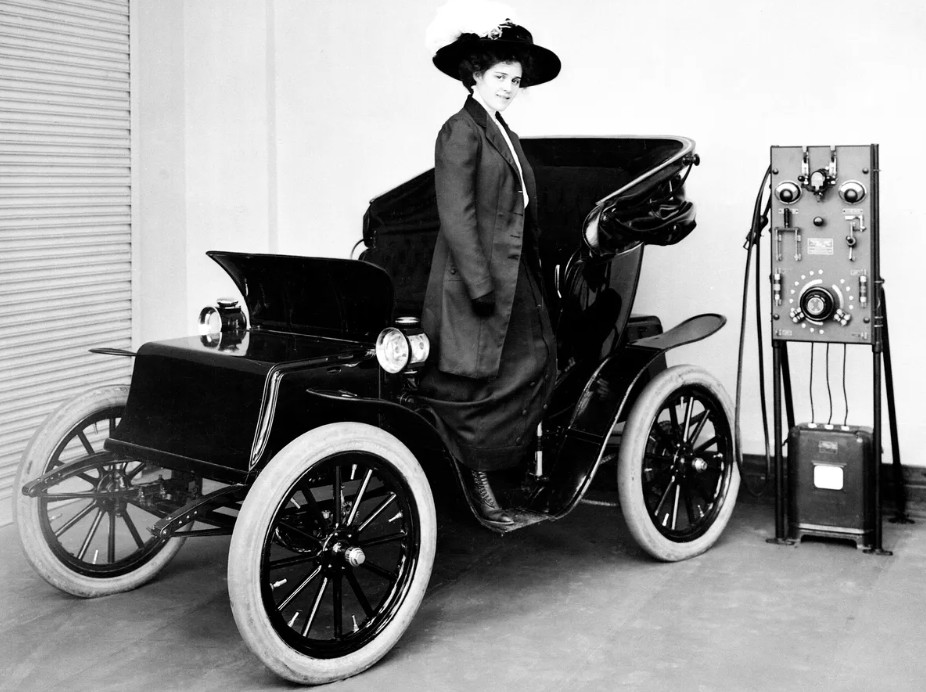
Electric vehicles were competing with steam and gasoline automobiles more than a century before today’s EV boom. IEEE Spectrum explores this early period through Fannie Goodnow, a Boston-area woman who owned a 1908 Bailey Victoria Phaeton and charged it using a General Electric mercury-arc rectifier.
At the beginning of the 20th century, no automotive technology had clearly emerged as the winner. Steam vehicles posed heat and fire concerns, while gasoline cars were noisy, produced exhaust, and required hand cranking before the electric starter arrived in 1911. Electric cars were comparatively quiet, clean, and easy to start. Manufacturers used these characteristics to market EVs specifically to women, while General Electric advertisements showed fashionable women operating charging equipment.
Goodnow’s charging system illustrates the sophistication and limitations of early EV infrastructure. The mercury-arc rectifier converted AC electricity from the grid into DC for battery charging. A depleted battery took about 12 hours to recharge. Charging connectors were not standardized, forcing some early motorists to carry adapters and cables, an issue that echoes modern EV charging compatibility concerns.
The Bailey Victoria Phaeton also reflects rapid changes in battery technology. Its original Edison alkaline battery suffered from leakage and poor charge retention, prompting Bailey to adopt lead-acid batteries from Gould Storage Battery. Goodnow’s 30-cell battery provided a range of roughly 64–80 kilometers. The car cost $2,000, equivalent to about $73,000 today.
Thomas Edison eventually improved his battery, and Bailey demonstrated its capabilities through a roughly 1,600-kilometer promotional journey. Yet the technology arrived as Henry Ford’s Model T was helping gasoline vehicles dominate the market. Unable to compete, Bailey sold its factory in 1915 after producing only about 500–600 EVs. Goodnow’s surviving charger now serves as a reminder that many challenges associated with modern electric mobility, including range, charging infrastructure, connector standards, and battery performance, have roots stretching back more than a century.
