

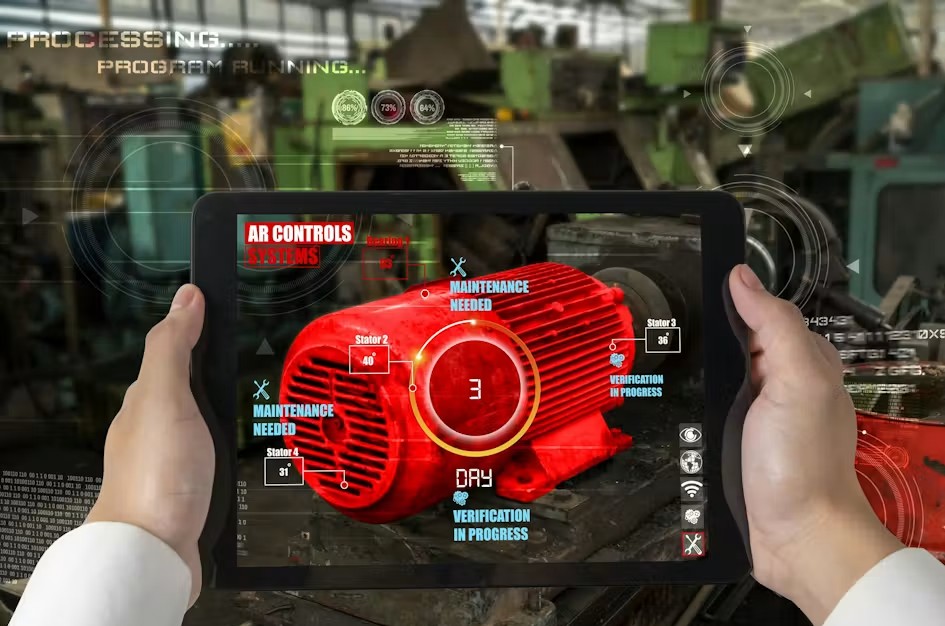
Electric motors power everything from household appliances and cordless tools to robots, industrial equipment, and electric vehicles. Their continuous operation makes mechanical wear and electrical degradation unavoidable. Machine Design explains that advances in Edge AI are making predictive maintenance practical across a much wider range of motor-driven systems.
Predictive maintenance differs from reactive and preventive approaches by continuously analyzing operating data to identify degradation before equipment fails. Condition monitoring supplies the underlying information through signals such as motor current, vibration, temperature, and back electromotive force. Embedded processors can now analyze these signals locally rather than relying entirely on centralized computing systems.
Processing data at the edge offers several advantages. Systems can detect critical faults with low latency while sending only health indicators or anomaly alerts elsewhere, reducing bandwidth and cost. Smaller devices can also reuse signals already available for motor control. Phase currents and back-EMF, for example, can reveal bearing wear, rotor imbalance, friction, and electromagnetic problems without requiring additional sensors.
Industrial motors can employ more specialized techniques, including vibration analysis and motor current signature analysis. Machine learning expands these capabilities by identifying patterns that fixed diagnostic thresholds may miss. Compact neural networks can analyze vibration or current data and track degradation trends while running on resource-constrained embedded controllers.
A typical Edge AI system collects and preprocesses motor data, extracts useful features, and applies a trained machine learning model. The resulting health classifications, anomaly scores, or remaining-useful-life estimates can trigger alerts or adjust operating parameters.
Emerging technologies could extend these capabilities. Digital twins can compare expected and measured motor behavior, while federated learning allows distributed devices to improve models without exchanging raw operational data. Integrated sensors could provide richer diagnostic information. Predictive maintenance may also increasingly connect with adaptive control, enabling equipment to reduce loads or modify operation when deterioration is detected.
Together, these developments are moving predictive maintenance from specialized industrial installations into everyday motor-control architectures.
