

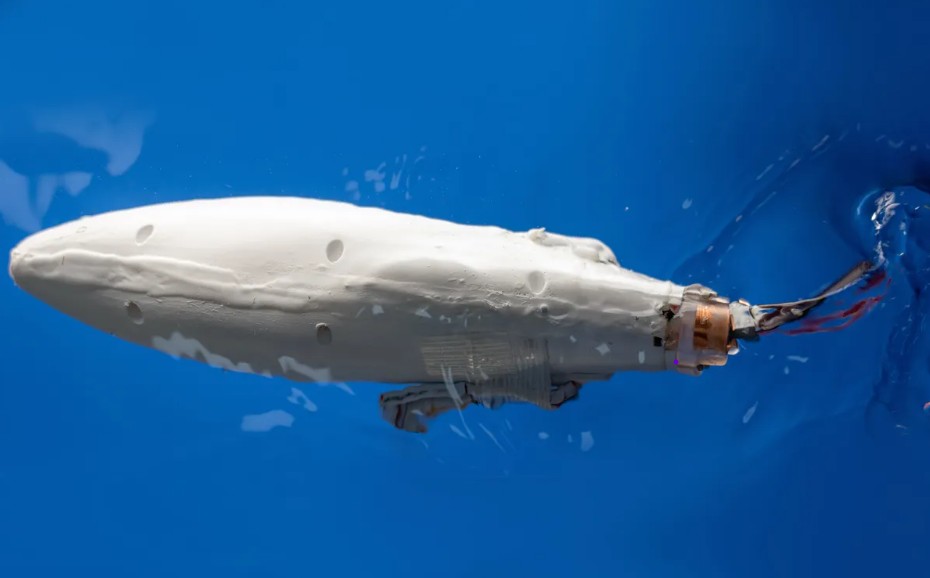
Engineers at Zhejiang University and affiliated labs have created a novel fin design for an underwater robot: instead of using traditional motors and rigid linkages, the fin is actuated by an electromagnetic mechanism comprising two small coils and spherical magnets embedded in an elastic joint, tells IEEE Spectrum. When alternate current flows through the coils, an oscillating magnetic field causes the fin to flap back and forth like a fish tail; when the field stops, the fin returns to neutral.
In tests, the robotic swimmer achieved a forward speed of 405 mm per second (about 1.66 body lengths per second) and could turn within a radius of just 0.86 body lengths. The fin itself weighs only 17 grams, yet it produced a peak thrust of 0.493 N, impressive given the size and weight. The team also developed a mathematical model linking the electrical input (current, frequency) to hydrodynamic output (thrust, motion), enabling predictive design rather than trial-and-error.
One of the major benefits of this electromagnetic fin is the combination of flexibility (unlike bulky rigid actuators) and significant thrust (unlike many soft robotic designs). The elastic joint design reduces friction and simplifies the actuator, making it more efficient and compact. However, challenges remain: the system consumes considerable power due to the electromagnetic coils, which limits operational duration. The researchers are exploring coil geometry optimization, energy-recovery circuits, and smarter control strategies to reduce energy draw.
Applications highlighted include underwater exploration, ecological monitoring (e.g., coral reef inspections), and other aquatic tasks where agility, low disturbance, and compact design are valuable. For engineers designing underwater systems, this development signals a shift toward actuators that blend material flexibility, electromagnetic control, and hydrodynamic performance. This electromagnetic fin design marks a promising step forward in biomimetic underwater robotics.
