

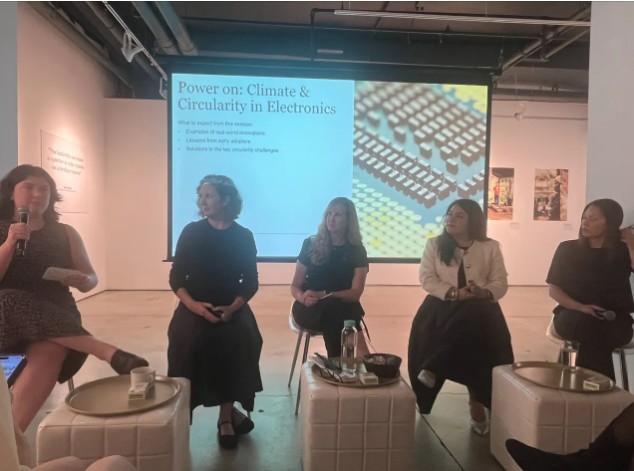
Electronics-industry veterans at the Climate Week NYC event highlighted two major obstacles to circularity: intricate component assemblies and inconsistent regional recycling infrastructures. With product cycles accelerating and devices becoming more complex, the feasibility of reclaiming and reusing parts from old electronics diminishes rapidly, tells Design News. For example, a demonstrator circuit board shown at the session helped capture the audience’s attention: hundreds of distinct components must be individually removed or processed for reuse. This complexity raises costs and limits reuse potential.
Another key observation: product design plays an outsized role in enabling sustainability. Panelist Barjouth Aguilar (Head of Global Sustainability Program at Flex Ltd.) emphasized that design decisions, such as materials chosen, manufacturability, disassembly, and component standardization, are pivotal for downstream recycling and refurbishment. Meanwhile, Cassie Gruber (Director of Sustainability Business Solutions at Jabil Inc.) pointed out that while some semiconductor chips hold reuse value, entire printed-circuit-board assemblies often end up discarded due to mixed materials and low economic separation.
Regional differences in recycling infrastructure also emerged as a blocker. Kelly Scanlon from the Global Electronics Association noted the uneven availability of facilities capable of reclaiming key materials such as copper. Some U.S. states lack nearby processing plants; in contrast, countries such as Japan have integrated “take-back” programs where manufacturers accept end-of-life electronics at retail or depot sites.
The experts underscored that no single player can solve this in isolation: manufacturers, regulators, retailers, and consumers must collaborate to create circular supply chains. Design strategies, regulatory drive, and investment in recycling infrastructure are all required.
Sustainability starts well before production; it begins at concept. If design doesn’t account for end-of-life, true circularity remains a distant ideal.
