

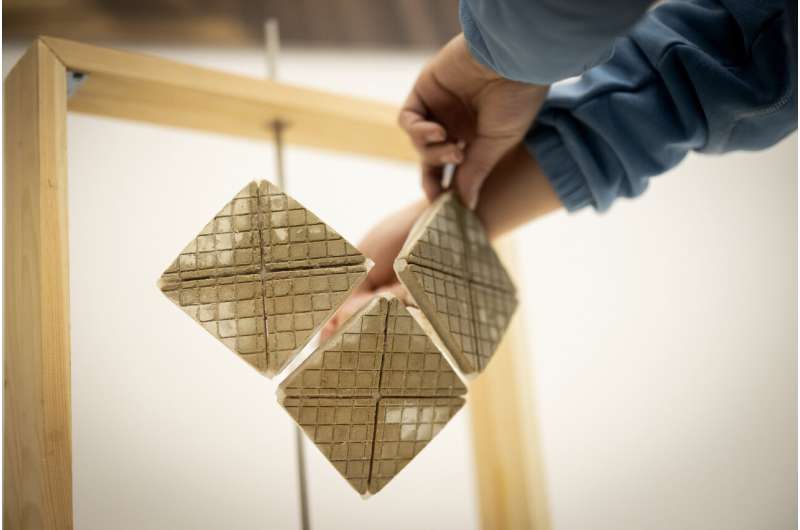
Researchers at the University of Pennsylvania have developed a cement-based building tile inspired by the skin of African elephants that cools buildings without electricity. The passive cooling material mimics the network of tiny cracks in elephant skin, which trap water and allow it to evaporate gradually, helping the animals regulate their body temperature. By adapting this natural strategy to construction materials, the researchers have created a low-cost façade system that could reduce reliance on air conditioning while lowering energy use and greenhouse gas emissions, tells Tech Xplore.
The innovation combines ordinary Portland cement with diatomaceous earth, a naturally porous material made from fossilized algae. During manufacturing, the tiles are dried under carefully controlled conditions that create a predictable network of microscopic cracks rather than random fractures. These engineered cracks work with the material’s internal pores to absorb, transport, and retain water. Instead of allowing droplets to run off the surface, the crack network redistributes moisture across the tile, where it evaporates slowly and removes heat from the building.
Laboratory tests demonstrated significant cooling performance. Under infrared heating and periodic watering, surfaces protected by the elephant-inspired tiles maintained a temperature of about 89.6°F (32°C), compared with 107.6°F (42°C) for cracked commercial stucco and 125.6°F (52°C) for conventional stucco. The passive system reduced surface temperatures by approximately 10–20°F (6–11°C) and sustained cooling for up to 20 hours after watering. Unlike conventional air conditioning, which consumes electricity and releases waste heat outdoors, the new material cools the building envelope directly without compressors or moving parts.
The researchers believe the technology can be manufactured economically because the cement-diatomaceous earth mixture is compatible with existing construction methods, including spray application over large surfaces. Looking ahead, the team envisions pairing the tiles with automated watering systems controlled by weather forecasts, ensuring that only the required amount of water is supplied during hot conditions. By combining bio-inspired materials with intelligent water management, the approach could provide an energy-efficient way to improve thermal comfort in cities facing increasingly frequent and intense heat waves.
