

Artificial intelligence (AI) is expanding its role in scientific research beyond data analysis and predictive modeling to the physical execution of experiments. Researchers from University College London, the Hong Kong University of Science and Technology (Guangzhou), and collaborating institutions have developed an Embodied Science Agent (ESA) that integrates computational intelligence with robotic automation, tells Tech Xplore.
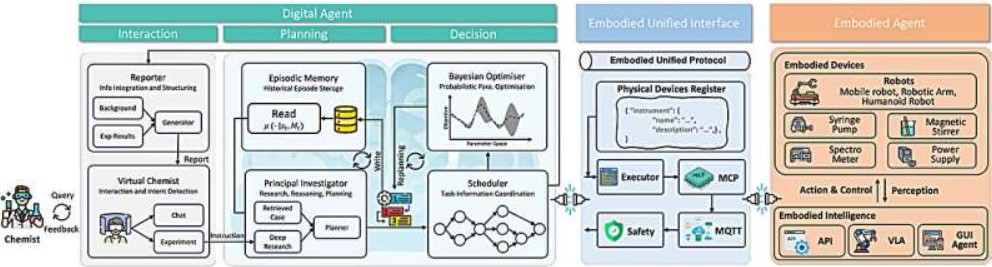
Traditional AI research systems often separate experimental design from physical execution, limiting their ability to learn from interactions with laboratory equipment. ESA addresses this limitation through three interconnected components: a digital agent, an embodied agent, and a coordinating interface.
The digital agent evaluates historical experimental data and employs Bayesian optimization to identify promising experimental parameters. The embodied agent operates laboratory instruments while adapting to environmental variations. The interface establishes communication between computational reasoning and robotic execution, creating a continuous feedback loop.
Researchers evaluated the system through wastewater treatment experiments involving dye removal. ESA explored an experimental space containing more than 200 million potential parameter combinations. Over 15 successive experimental rounds, solution transmittance increased from 82% to 99.7%, representing a 98.5% reduction in residual dye concentration.
Additional testing demonstrated the robot’s ability to manipulate laboratory equipment despite changes in instrument positioning. However, successful decolorization does not necessarily establish complete dye decomposition or the elimination of other contaminants.
The research highlights an important distinction between conventional laboratory automation and adaptive scientific experimentation. Rather than simply executing predetermined instructions, embodied AI can use experimental outcomes to refine subsequent decisions.
For engineers and researchers, this approach offers opportunities to reduce repetitive manual work, accelerate experimental optimization, and investigate complex problems more efficiently. Potential applications could extend across materials science, chemical engineering, and environmental research.
Although further validation across scientific disciplines is necessary, the study represents a promising development in autonomous laboratories, where AI and robotics work together to support continuous learning, experimental refinement, and scientific discovery.
