

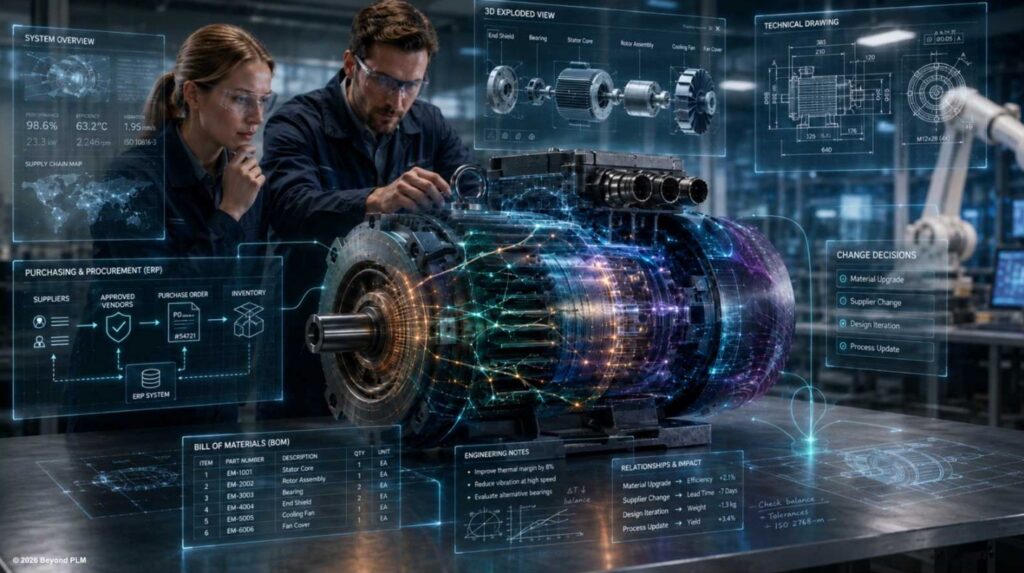
In a recent article on Beyond PLM, Oleg Shilovitsky argues that the next major evolution in engineering software will not center on storing more product data, but on preserving the context behind product decisions. He calls this emerging layer “product memory,” a system designed to capture not only files, revisions, and approvals but also the reasoning, assumptions, trade-offs, and historical relationships that explain how a product evolved over time.
The article positions product memory as a response to a growing weakness in traditional PLM systems. Existing platforms are effective at recording formal outcomes such as engineering change orders, approved revisions, and lifecycle states. However, they rarely preserve the conversations and decision-making processes that shaped those outcomes. As a result, critical engineering knowledge often disappears into emails, spreadsheets, meeting notes, or the memories of experienced employees.
Shilovitsky argues that this missing context has become especially important as AI agents begin participating in engineering and manufacturing workflows. Large language models can analyze information, but they struggle without persistent, structured context. Product memory is proposed as the “context layer” that would allow AI systems to understand why a supplier changed, why a design was simplified, or why certain manufacturing constraints were accepted.
The concept also extends beyond a single software platform. Product memory is described as a connected layer spanning CAD, ERP, PLM, procurement, manufacturing, and supplier systems rather than replacing them. In this framework, the digital thread links product data, while product memory preserves the organizational reasoning surrounding it.
The article ultimately frames product memory as a shift in engineering architecture driven by AI adoption. According to Shilovitsky, the future of PLM may depend less on managing files and workflows and more on building systems capable of retaining the institutional memory that makes complex products understandable across teams, generations, and intelligent agents.
