

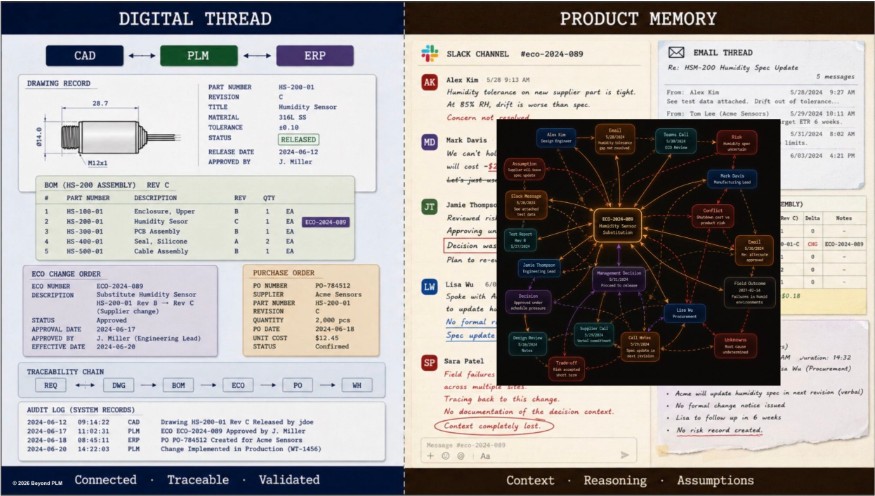
A recent article on Beyond PLM argues that engineering organizations are reaching the limits of traditional digital-thread strategies and need a more comprehensive way to preserve industrial knowledge. The article introduces the concept of “product memory,” a framework designed to capture not only product data but also the reasoning, decisions, trade-offs, and historical context behind engineering work.
The author explains that digital threads and product lifecycle management systems have long focused on connecting technical data across design, manufacturing, maintenance, and operations. While these systems improve traceability and process coordination, they often fail to preserve the deeper institutional understanding that accumulates throughout a product’s lifecycle. Critical engineering knowledge frequently remains scattered across emails, meetings, spreadsheets, simulations, supplier discussions, and undocumented human experience.
According to the article, this gap becomes increasingly problematic as products grow more software-driven, multidisciplinary, and globally distributed. Engineers may inherit models, configurations, or requirements without understanding why earlier decisions were made. As experienced employees retire or teams reorganize, organizations risk losing the contextual knowledge needed to maintain continuity, avoid repeated mistakes, and accelerate innovation.
The proposed “product memory” approach attempts to address this issue by creating persistent knowledge structures that connect technical artifacts with engineering intent, decision histories, operational feedback, and organizational learning. Rather than treating engineering information as static records, the framework envisions living systems that continuously evolve alongside products themselves.
The article also connects product memory to emerging AI technologies. Large language models and intelligent assistants may eventually help engineers navigate decades of fragmented institutional knowledge, surface hidden relationships between decisions, and retrieve context that traditional PLM systems cannot easily expose. However, the author stresses that AI alone cannot solve the problem if the underlying engineering knowledge remains poorly structured or disconnected.
Ultimately, the article presents product memory as a strategic shift in engineering infrastructure. Future competitiveness may depend not only on managing product data efficiently but also on preserving the organizational intelligence embedded within complex engineering processes. As industrial systems become more interconnected and long-lived, the ability to retain and reuse engineering memory could become as important as the products themselves.
