

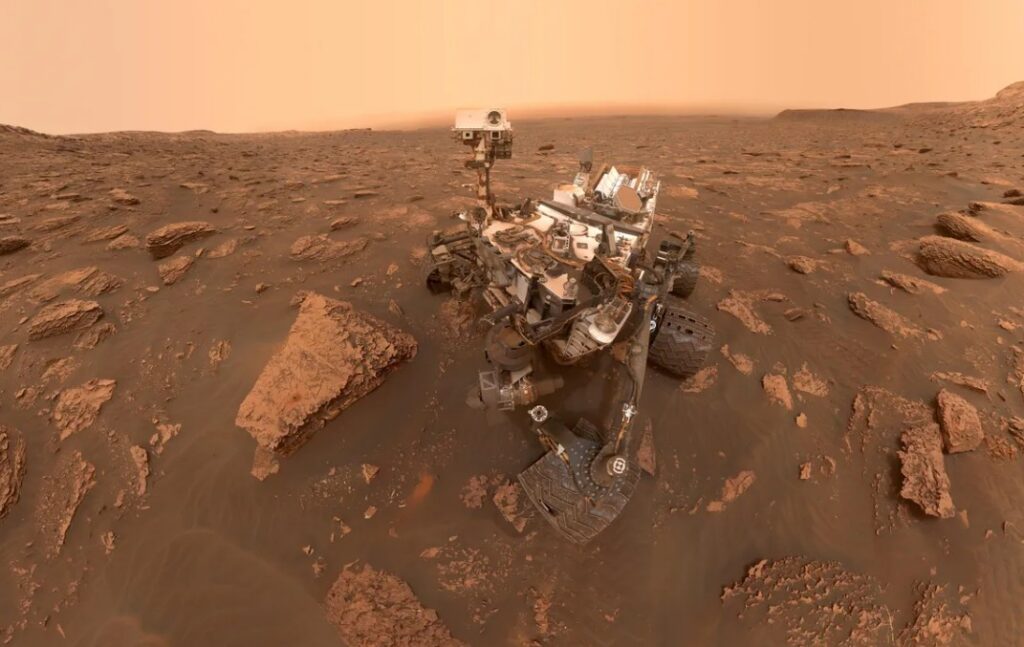
More than 13 years after landing on Mars, NASA’s Curiosity rover continues to conduct valuable scientific research despite operating in one of the harshest environments imaginable. An article in IEEE Spectrum examines the engineering innovations and operational strategies that have allowed the rover to far exceed its original mission lifespan while continuing to expand humanity’s understanding of Mars.
Since touching down in Gale Crater in August 2012 using the groundbreaking sky crane landing system, Curiosity has traveled nearly 37 kilometers, drilled into dozens of rock formations, and captured hundreds of thousands of images. Originally designed for a two-year mission, the rover remains productive thanks to continuous maintenance performed entirely through software updates sent across millions of kilometers of space.
The article features insights from Alexandra Holloway, assistant team chief for engineering operations at NASA’s Jet Propulsion Laboratory. She explains that Curiosity has become more capable over time as engineers developed creative solutions to address aging hardware, declining power availability, and damage caused by Mars’ rugged terrain. One of the rover’s most visible challenges has been wheel wear, prompting engineers to refine driving strategies and navigation techniques to extend mobility and reduce stress on vulnerable components.
Software improvements have also played a crucial role. Engineers have enhanced Curiosity’s ability to manage resources, operate more efficiently, and continue scientific investigations despite hardware limitations. These updates have effectively given the rover new capabilities without requiring any physical intervention.
Perhaps the most significant outcome of Curiosity’s longevity is the knowledge it has provided for future missions. Lessons learned from its operation directly influenced the design of NASA’s Perseverance rover, leading to stronger wheels, improved autonomy, and more advanced scientific capabilities. The experience has also informed planning for future robotic explorers intended to operate in similarly challenging environments.
Curiosity’s continued success demonstrates that planetary exploration depends as much on engineering resilience as scientific ambition. Through careful monitoring, adaptive software, and innovative problem-solving, the rover remains a powerful example of how thoughtful design can extend mission life far beyond original expectations while continuing to deliver groundbreaking discoveries from another world.
