

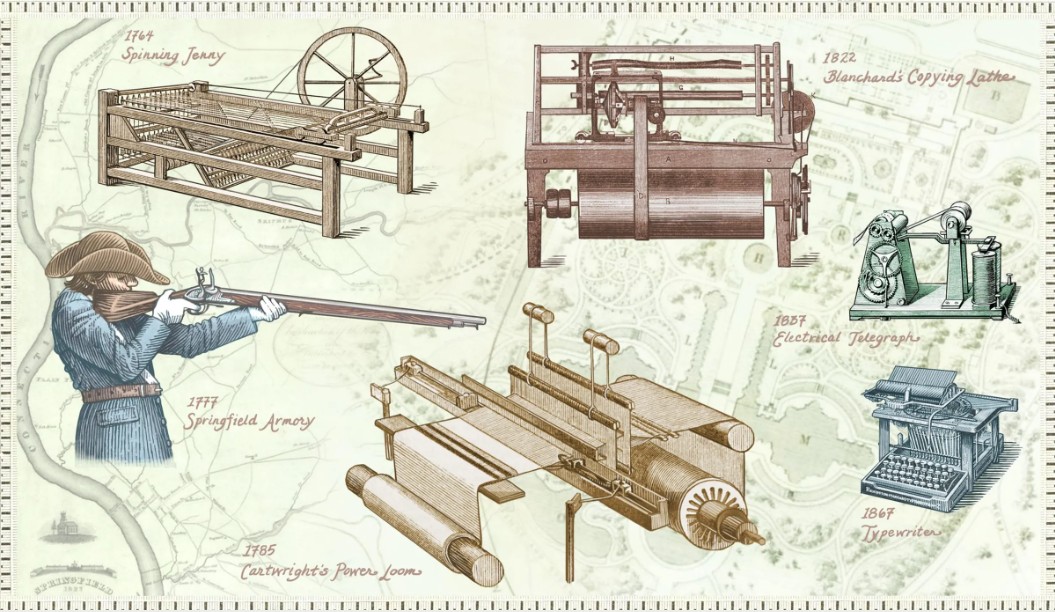
The IEEE Spectrum article argues that national sovereignty is not secured by political declarations alone. Instead, it must be continuously engineered through technological capability, industrial strength, and the ability to maintain critical systems. Using historical examples, the author shows that the United States built its independence not only through military victories but also through deliberate investments in manufacturing, engineering, education, and infrastructure.
The article traces this effort to the colonial era, when Britain restricted American industry through laws limiting textile, iron, and other manufacturing activities. After independence, the young nation responded by building its own industrial base. Innovations such as Samuel Slater’s textile mills, Simeon North’s interchangeable firearm parts, and Thomas Blanchard’s copying lathe transformed American manufacturing. Government policies, including protective tariffs and the establishment of land-grant colleges, further expanded technical education and industrial capability, helping the United States emerge as a leading industrial power.
The author contrasts that history with developments over the past several decades. Beginning around the U.S. bicentennial, financial priorities increasingly displaced manufacturing, encouraging companies to offshore production and adopt just-in-time supply chains. As factories closed, specialized suppliers disappeared, and experienced technical workers retired without being replaced. These changes weakened domestic industrial capacity, leaving sectors such as shipbuilding and naval manufacturing struggling to meet national needs.
The article also highlights another concern: the erosion of the public’s ability to repair and maintain the technologies they own. Restrictions imposed through software and service agreements limit users’ ability to fix equipment ranging from tractors to medical devices. According to the author, this loss of repair capability reflects a broader decline in technological self-reliance and public control over essential systems.
The article concludes that sovereignty is not a permanent achievement but an ongoing engineering responsibility. A nation preserves its independence by maintaining industrial expertise, supporting engineering education, protecting manufacturing capabilities, and ensuring that citizens retain the knowledge and right to sustain the technologies on which society depends.
