

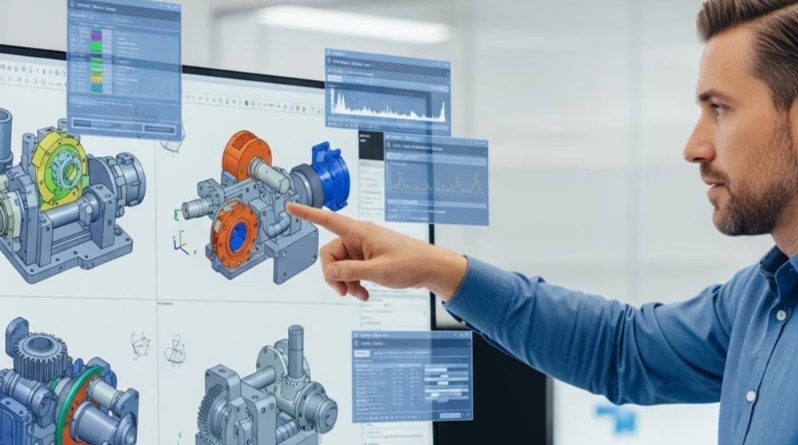
Mechanical engineers increasingly rely on artificial intelligence to improve productivity, but general-purpose AI assistants often lack the technical understanding required for complex engineering tasks. In this Leo AI article, cofounder and CEO Maor Farid explains why engineering-specific AI platforms could become essential to modern mechanical design workflows.
Traditional computer-aided design (CAD), product data management (PDM), and product lifecycle management (PLM) systems have transformed engineering. However, engineers still spend considerable time searching historical designs, preparing documentation, and managing repetitive tasks.
General-purpose AI tools can generate text and code but may struggle with mechanical assemblies, geometric constraints, tolerances, and engineering standards. Farid argues that specialized AI systems must understand these relationships while integrating with existing engineering software.
Leo AI addresses these requirements through its Large Mechanical Model (LMM), trained on mechanical components, assemblies, and engineering principles. The platform helps engineers retrieve existing designs, identify suitable components, generate documentation, and evaluate design alternatives.
Its capabilities extend to bill of materials preparation, material selection, supplier searches, and engineering calculations. The system can also identify relevant simulation parameters and constraints, supporting faster preparation for finite element analysis (FEA) and computational fluid dynamics (CFD).
One example involves mechanical engineer Ashraf Serour, who developed an ergonomic exercise attachment. Using Leo AI for concept development, calculations, and material selection, Serour completed the design and prototype in seven hours instead of approximately one week.
According to Leo AI, customer studies indicate savings of approximately five hours per engineer weekly and a 30% reduction in design and documentation errors. These figures are company-reported rather than independently verified.
The platform also emphasizes secure integration with existing engineering repositories, allowing teams to reuse historical knowledge without exposing proprietary information.
Although Leo AI does not replace CAD modeling engines or engineering verification, it demonstrates the potential of specialized AI to reduce administrative work, accelerate design iterations, and improve engineering decisions.
