

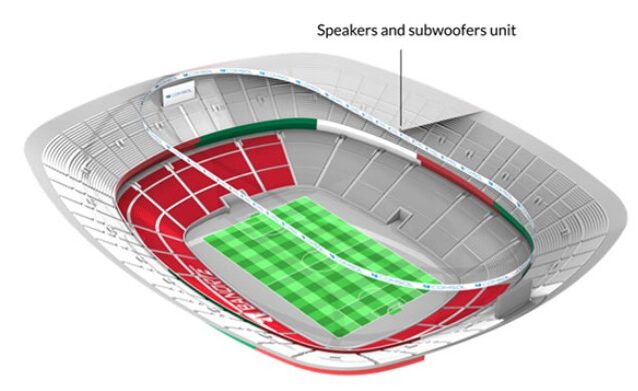
Mexico City’s Estadio Azteca occupies a unique place in football history. Having hosted iconic moments from Pelé’s World Cup triumph in 1970 to Diego Maradona’s unforgettable performances in 1986, it became the first stadium to host matches in three FIFA World Cups during the 2026 tournament. While its atmosphere is defined by tens of thousands of passionate supporters, the stadium’s sound experience also depends on sophisticated engineering, says Digital Engineering 24/7.
To explore the acoustics of the venue, researchers at COMSOL conducted a simulation-based study of the stadium’s public address system. The project examined how sound propagates throughout the massive structure and whether the system can meet FIFA’s acoustic performance requirements. These standards include a reverberation time below four seconds, a speech transmission index above 0.55, and sound pressure level uniformity within ±3 decibels, ensuring spectators can clearly hear announcements and match information.
The researchers created a simplified digital model of Estadio Azteca based on publicly available information. Because sound behaves differently across frequencies, multiple simulation techniques were required. At lower frequencies, wave-based acoustic modeling was used to capture complex effects such as diffraction. These simulations involved nearly 100 million degrees of freedom and were completed using high-performance graphics processing units.
For higher frequencies, the team adopted ray acoustics methods, which are computationally more efficient for large-scale environments. A boundary element model was first used to determine the radiation pattern of a representative loudspeaker cluster, and this information was then incorporated into stadium-wide sound propagation simulations.
The results showed that a single loudspeaker cluster could not achieve FIFA’s desired sound uniformity. However, when multiple speaker arrays work together, coverage becomes far more consistent across seating areas. By combining wave acoustics, boundary element modeling, and ray-tracing techniques, engineers can estimate sound pressure levels, reverberation times, and speech intelligibility throughout the venue.
Although the study was conducted primarily as an educational exercise rather than a professional stadium assessment, it demonstrates how advanced simulation tools can help engineers design and evaluate large-scale sound systems. Ultimately, however, the researchers acknowledge that the most powerful sound inside Estadio Azteca remains the roar of more than 80,000 football fans.