

We are a generation that has witnessed one technology revolution after another. There was the personal computer revolution, followed by the Internet revolution. Now we find ourselves in the midst of the AI revolution.
The AI revolution may be the most consequential ever. Computer revolutions have added jobs. AI sweeps jobs away. Not since the Industrial Revolution have so many jobs disappeared — and AI is just getting started.
AI is a tsunami moving at supersonic speed, says Elon Musk. AI poses an existential threat to companies, too. Software companies once considered AI a boon, enabling them to generate code faster than or instead of employees. Now they worry about their customers ditching their software in favor of AI.

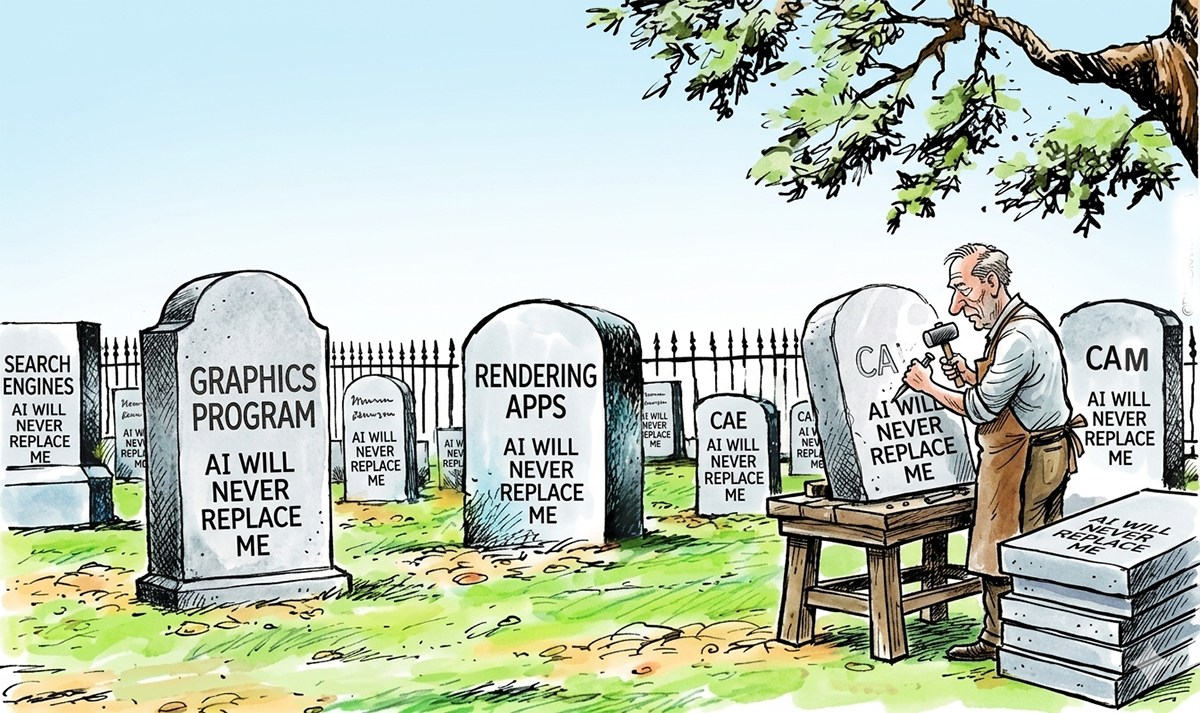
AI is starting to replace Google search for people looking for answers. It is replacing Photoshop when people want to make an image, replacing Word when creating articles (not this one, though). Claude can generate spreadsheets and PowerPoints. AI has also made inroads into design and engineering. 3D scenes can be rendered by AI and AI can replace simulation.
How long before AI does away with CAD as we know it?
Google Issues Code Red
On November 30, 2022, OpenAI released ChatGPT. If you are an optimist, human history split neatly into a before and after. If you’re a pessimist, humans entered their final chapter. If you are a tech CEO, you were busy responding to demands to get on the AI wave but secretly praying the fad would soon be over.
It would have been easy for Alphabet’s CEO, Sundar Pichai, to dismiss ChatGPT as a fad Here was a chatbot barely out of the lab. Google, part of Alphabet, on the other hand, was in a very comfortable place. Forgotten now is that Alphabet was actually leading the industry with AI. Google had been supplying answers to questions for years when ChatGPT burst upon the scene. You could ask Google how your team was doing and it would give you the up-to-the-second score. ChatGPT couldn’t do that. Google’s immense computing power seemed capable of indexing every site and reacting to changes by the second. No startup could do that.
But ChatGPT was friendlier and eager to please. Its answers were longer and more impressive. You could ask it for an answer to an essay question and practically guarantee a good grade. It could have a conversation with you, make jokes, be your companion, plan your vacation. It could be serious, too, talk you through a depression, help you diagnose your symptoms. Never mind that it would sometimes make things up. It was fun.
And suddenly, Google was what your parents used.
Sundar could have done nothing. Instead, he issued a Code Red. In a series of meetings that redefined Google’s AI strategy, he redirected several groups within the company to release Google’s answer to ChatGPT, which was still being tested and tweaked.
Gemini was launched on December 6, 2023, a little over a year after ChatGPT was released. Gemini’s answers today are on par with ChatGPT and Claude.
Crisis averted.
Pretty Pictures
Getting an image today requires only that you ask Gemini for it — and you can do it in plain English. Unlike software applications that force you to learn their language, ChatGPT, Gemini, Claude and other LLMs (large language models) understand your language. To use Photoshop, you have to know what all the icons mean (no, they are not self-explanatory), memorize where they are and what they do, plus learn the menu structure and all of the terminology. Like most professional software programs, it takes months to learn, years to master. Photoshop veterans say it is easy to use. Sure, easy to use if you know how. Everyone else is banging their head on the screen.
I pay dearly for a subscription to all Adobe has to offer only to use it on occasion. I stay at the beginner level. What may take a Photoshop veteran a few minutes becomes 10 minutes watching how-to YouTube videos, a half hour floundering through the commands and giving up after an hour of videos that have nothing to do with Photoshop.
Last week, I had an epiphany. I needed to replace text in an image. Instead of using Photoshop to replace the text, I asked Google’s Gemini to do it. In about as much time as it would have taken to start up Photoshop, Gemini had called upon Nano Banana, its image engine and neatly and perfectly replaced two text strings.
I pay nothing to use Gemini. I wondered if I’d ever use Photoshop again.
Meanwhile, Back in the Office
Microsoft spent a generation unsuccessfully trying to keep up with Google’s search, so it was not about to be caught flat-footed when AI burst upon the scene. Perhaps realizing that generative AI would reduce sales of its Office suite, Microsoft invested heavily ($13B) in OpenAI and licensed ChatGPT for its Office Copilot, which is directly in the core of Office applications. The company recently rolled out “agentic” modes in Word, Excel and PowerPoint that let users describe what they want and have the software generate a whole document.
Satya Nadella, CEO of Microsoft, may have expected the crisis to be over, as did Sundar Pichai of Alphabet.
PCWorld doesn’t think so.
“A quick survey of our office reveals no one uses Copilot — and we’re PCWorld for Pete’s sake,” says senior editor Mark Hachman in his July 2, 2026 Smart Mode column. “And while millions of users have grown up with the Office apps, is anyone really a ‘fan’ of them? Feature creep has given Word, PowerPoint and Excel extremely heavy, often indecipherable interfaces, while the LLMs are basically just single-field chatbots.”
Claude can easily create impressive-looking spreadsheets and PowerPoints. My documents look quite drab next to Claude’s, which are neatly formatted, attractive, colorful and even have pictures and charts.
Is That a Silent Alarm I’m Hearing?

Stand-alone AI is getting more useful while keeping things simple, which traditional software has failed to do. While in some software categories, alarms went off and companies reacted, in others they did not.
Adobe is only too well aware of the threat from AI as growth has slowed down in the age of AI. A SWOT (strengths, weaknesses, opportunities, threats) analysis on Investing.com points to pricing pressure as AI tools reduce the perceived value of Adobe software’s strengths. This has led to faster-than-expected market share losses in Adobe’s consumer and small-business segments. Adobe’s shares declined approximately 22% in 2025.
Adobe, with an $87B market cap, is bigger than Autodesk ($61B) and once had an unassailable position in image content creation and modification. It has withstood challenges from lower-priced software and SaaS. Adobe must have thought it was too big to fail. Then AI showed up.
I’m reminded of the large mammals that once roamed the Earth, too big to fall to predators. Then man showed up.
The software industry’s incumbents — Microsoft, Adobe, Oracle— are the large mammals of enterprise software: large, established, dominant in their categories. They do fine in a world without disruption. But AI is like man, the smart, new hunter. The large incumbents may not know how to deal with the threat.
But CAD is Safe from the AI Threat, Right?
Since ChatGPT took the world by storm, I have attended several conferences held by design and engineering software companies. All have been under the cloud of AI. AI is the main subject on the main stage, the sessions, the hallways and at the table for meals. But the actual implementation of AI has been like watching a revolution in slow motion.
At the annual SolidWorks conference (3DEXPERIENCE World) in February 2023 in Nashville, EVP Suchit Jain of Dassault Systèmes talked excitedly about ChatGPT after using it to generate code to model a staircase.
“It was 95% correct,” he said.
Still, there was no mention of implementing AI in the product.
Most of the early discussion was about LLMs and CAD companies deflected expectations of AI implementation. LLMs may be useful for less serious applications, I was told more than once, but entirely useless in doing CAD, which is all about geometry, shapes, NURBs, etc.
Autodesk took an early lead in downplaying LLMs while claiming they had AI all along. True, they had introduced auto-dimensioning in drawing views but it was only a modest improvement over the previous capability. They pointed to generative design (AKA topology optimization), their software to generate strange, unmanufacturable shapes, as another example of AI.
Downplaying LLMs and deflecting AI demands gradually gave way to the implementation of LLMs. LLMs have now been harnessed to sift through help documentation and answer natural-language questions about which commands to use and when.
That’s nice but I’d still rather find a YouTube video for that. With so many users posting video tips, I usually have no trouble finding one.
In-app AI would be more useful if, instead of telling me how to do something, it would actually do it. I dream of in-app AI that, when asked to create an extrusion, it responds with “What shape do you want to start with?” If I answer “circle,” it asks “What diameter?” The dream continues. I’m a bike designer and I work with round tubes to make diamond-shaped frames. The AI already knows the OD and wall thickness I prefer in my tubes and asks “What size frame?”
AI as the Engineer’s Assistant
In my role as an editor in tech media, I have plenty of opportunities to interact with executives and product managers in design and engineering software. To them I direct my impatience. I am tired of hearing about yet another CAD that can read and answer from help docs. That’s just you guys going after low-hanging fruit. I demand that you do more with AI, actually make usable designs. But almost always, I am told “That’s not how it works,” lectured about the limits of LLMs and reminded that LLMs are large language models. They cannot handle geometry, shapes, matter, forces…
But I want it to. I want it to understand what I’m trying to create and help me create it? I am spoiled by Google which finishes my search term. It’s called typeahead or autocomplete.
Why can’t CAD do that? Why can’t an AEC application know when I make a line, I mean a wall? And if that wall is part of residential construction, it should be made with 2×4 framing, sheathing and drywall. And by the way, the 2×4 measures 1.5 by 3.5 inches. Know that. I want my CAD to understand context, history, standards… It’s only been watching me do all that year after year. Why can it not remember? Isn’t that what AI should be helping CAD do?
Let’s Get Physical
LLMs are nice but what AI engineers really need is one that understands geometry, shapes, matter, forces — not just words — and AI that understands the world we live in, a world in which objects cannot move through each other, a world with gravity, resistance to touch, impermeable solids… CAD companies may have found this AI in an unlikely place.
Physical AI was introduced by Nvidia’s Jensen Huang at CES in January 2025 to make humanoid robots more human. Here was AI that could give robots a light touch — so important for robots that are being butlers, cooks and maids in the presence of their masters. Unlike industrial robots that operate within protective cages, humanoid robots must interact socially and carefully around humans. Being able to get a beer from the fridge without stepping on the dog’s tail is preferable. Being able to shake a hand without crushing it is desirable. Getting a knife out of the drawer without slashing someone is a must-have.
Physical AI is not about language but about shapes, forces and physics… It claims to understand the physical world. The exact level of understanding of the physical world remains to be seen. Physical AI has not appeared in the real world as of yet. It is currently little more than a concept.
Nonetheless, physical AI is now the buzzword. All those who saw LLMs as worthless in the world of engineering now have something they can’t deny. Engineers can dream of their designs behaving as they would in real life, not just pixels on the screen. We imagine parts that come into contact with each other and snap into place like in real life. We won’t have to do clash detection because pipes simply cannot occupy the same space as a steel structure. Like real life. The office furniture in the newly designed office space stays on the floor. Real life.
What is Physical AI?
Physical AI isn’t a single product — it’s an umbrella term for four interlocking NVIDIA platforms that are meant to usher in humanoid robots, the next big thing, according to Jensen.
Physical AI consists of 4 parts.
- Omniverse, a simulation/digital-twin platform
- Isaac, a robotics development stack
- Cosmos, “world foundation models,” launched at CES 2025
- GR00T, robot-specific foundation models
Only the Omniverse and Cosmos parts of Physical AI are of interest in this story.
Design/engineering software vendors (except one, more on that later) have all jumped at the chance to use Omniverse and Isaac. Not usually for robots, though. It turns out that what is useful for designing robots can be applied to any product. Physical AI imparts a physical sense unavailable with CAD or LLMs. Whereas CAD lets you move solid models through one another, physical AI does not. Physical AI has the potential to mate parts correctly, sliding and snapping into position. With physical AI, furniture will sit on the floor because it understands gravity and hard floors.
NVIDIA has made Omniverse and Isaac free for R&D. Dassault and PTC already plan to embed them in their own products, if they have not already, as do all major players in the design and engineering software world except one. (Autodesk. Wait for it).
Jensen says NVIDIA, despite its leadership in GPU chip manufacturing, is a software company. He is correct insofar as NVIDIA has created software and software platforms for developing applications that use its chips. NVIDIA did not create AI software but it certainly benefits from it, since machine learning thrives on GPUs.
- Siemens (Digital Industries Software) was among the first-wave adopters of NVIDIA software, alongside Ansys and Cadence, integrating NVIDIA Omniverse into its solutions since at least GTC 2025 and expanding further in 2026.
- Dassault Systèmes and NVIDIA announced a long-term strategic partnership in February 2026 to establish a shared industrial architecture for mission-critical AI, combining Dassault’s Virtual Twin technologies with NVIDIA AI infrastructure to build science-validated “industry World Models.”
- PTC has two separate NVIDIA tracks: integrating NVIDIA Omniverse technologies into Creo and Windchill, announced in July 2025 and a March 2026 workflow that connects Onshape directly to NVIDIA Isaac Sim, enabling teams to simulate robot designs and support downstream robotic training in NVIDIA Isaac Lab.
- Cadence integrated Omniverse into Allegro (its electronic CAD tool) and its Reality Digital Twin platform, part of NVIDIA’s original physical AI push at CES 2025.
- Trimble was exploring the integration of NVIDIA’s Omniverse smart-city blueprint into its reality capture workflows and the Trimble Connect digital twin platform, announced in mid-2025.
- Bentley Systems partnered with NVIDIA on a smart-city physical AI blueprint. Cesium, its 3D geospatial platform, feeds into Omniverse. However, Bentley’s VP of Civil Infrastructure, François Valois, stated at a 2025 NVIDIA GTC panel that Bentley is training its own model (OpenSite+) using mostly synthetic data.
Autodesk Goes Its Own Way. Again.
Who’s missing on the NVIDIA Physical AI train? Autodesk.
Autodesk has been developing its own brand of AI. We should not be surprised. Remember when Autodesk bought the rights to ACIS so they could fashion their very own geometry kernel when the rest of the design industry standardized on Parasolid?
Autodesk has devoted substantial effort to creating its own physical AI. Autodesk SVP of Research, Mike Haley, claims to have the lead in CAD-related AI with over 100 peer-reviewed research papers published on the subject.
Autodesk has developed “neural CAD,” a proprietary foundation model architecture. This is a fundamental change in the way CAD is built, with a neural engine, essentially an AI black box, instead of hardwired programming code.
But whether AI can behave when making shapes remains to be seen. Text-to-CAD apps attempted by startups can be maddeningly creative when asked to create a shape. What works for “Why would Hamlet wait to avenge his father’s death?” fails when asked to make a spur gear with teeth that can actually mesh. Engineering requires tools that are precise and reliable. We don’t want a bracket that, each time we ask, has to be invented from scratch.
Making a CAD program with an AI engine is a mind-boggling proposition at best and at worst, a mission to Mars. But what do we know?
Mike Haley makes a case for reinventing CAD with a neural network engine. It is “foundationally different,” he says, not just ChatGPT bolted onto regular CAD.
“Anyone can take a large language [model] and put it against a CAD API. You can only get so far doing that. It can’t reason in 3D or the physical world. These models work natively in that 3D space.”
AI for UI
Physical AI does not rule out the use of LLMs, which should be quite useful in design and engineering software applications as user interfaces. A natural language interface could conceivably help first-time users get up to speed on the most sophisticated simulation applications, as TSFwaves for HFSS and the Ansys app for radiation analysis do. It could generate design variations for exploration and help identify optimal shapes, as nTop does. It could do what FEA and CFD codes do for the behavior of solids or fluids, as Neural Concept does. It could work in concert with existing LLM-based applications, or in their stead, using physical AI.
Consider CAE and simulation during its earliest days. NASTRAN, one of the first finite element codes available to engineers, was limited to the most privileged, most educated among us. Today, simulation software is available to designers without an engineering education. The interface was once punch cards and the results were picked up on green bar sheets the next day. Now, the simulation is run on Windows laptops. There was a time you fretted over the mesh being just right; now you are content to let the mesh be created for you. Never mind that there are a million elements; today’s CPUs and GPUs will take care of it and show the results in minutes or even seconds. AI could make simulation even more accessible and faster and further submerge meshing, solution and review. The engine is still under the hood but with AI, there may never be a need to pop the hood.
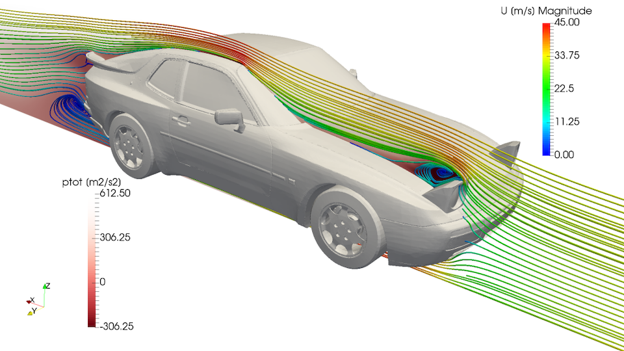
Neural Concept, an AI-based start-up, gives reliable answers to fluid flow problems without actually doing any calculations. It does not solve fluid flow’s governing equations, or use handbook simplifications, or the gold standard: a CFD solver. The company does it by essentially making an educated guess. It may not be as controlled or fine-tuned a model as you would get from an analyst using Ansys but results are quicker. And if Neural Concept is to be believed, it is close enough to what you would get with the old, time-honored methods.
Really? Are we that close to asking AI to “Will this break?” or “Will this fly?” and having the AI figure out how, either by inference, as does Neural Concept, or by calculation, as does ANSYS? How close are we to an AI agent that can handle the laborious tasks of defeaturing, meshing, solution, result review and then repeating the process with modifications over and over again?
If this is the way simulation is going the way of AI, with simple prompts that generate a flurry of computing out of sight and of no concern (until you get the bill for tokens, anyway), deliver pat answers and ask, “Would you like a detailed report?”
What engineer would say “No” to that? We love the stress contour plots and the streamlines. We hate writing reports.
Consider AI progress with visualization. Photorealistic rendering using ray-tracing is the gold standard. But rays can bounce around indefinitely. If you see ray tracing in progress, the image gets sharper and sharper, the lighting more and more lifelike, etc. It could literally go on forever but at some point the refinement exceeds what you can discern and there is no point in further calculation. But as they say for coding and which also applies to simulation, which converges asymptotically to a result, “The last 10% takes 90% of the time.” Converging to a result is just one of AI’s superpowers. AI can, in theory, tell an object in an image starting to form and finish the job, for example.
NVIDIA’s RTX, including 3D rendering and CAD-adjacent software, doesn’t use object recognition but nevertheless dramatically improves ray tracing, speeding up final renders to near-real-time in interactive situations, such as CAD and gaming. It’s the same underlying RTX/Omniverse technology that Dassault, PTC and others are now building with physical-AI.
Is AI-based Design Around the Corner?
With AI making such progress in visualization and simulation, how long before we can ask AI to create shapes for machines, cars, buildings…

A Belgian employment agency dared AI to finish a building in August of 2023. Almost three years later, it’s no longer a joke.
Autodesk’s first AEC-related foundation model, neural CAD for buildings in Forma, is already designing buildings. They may be crude renditions of block shapes at the moment but, as Autodesk promises, increased detail is coming, followed by the design of the building’s systems (electrical, plumbing, HVAC, etc.). We will have to wait a bit longer for robots to finish the building, still very much a labor-intensive process in the AEC industry but we have to look further than the other side of Autodesk’s business for all-the-way-AI. It is in manufacturing, more digitized than AEC, where an engineer can fire and forget. Send the model to the shop and have the machines (CNC machines in this case) produce the part. CNC (computer numerical control) machines run on code (known as G-code), which is a cinch to create with ChatGPT or Claude.
Engineers can easily dismiss AI’s attempts at creating parts, products and buildings as superficial. Indeed, most of them are only creating shapes without any regard to what’s inside. Engineers, more than architects, know it’s what’s inside that makes it all work.
We can reassure ourselves that the process- thinking of a product, making it work, manufacturing it… it’s all still too much to hand off to AI. AI is not ready for it. What engineers are doing is far too complicated. Too precise. And besides, let’s not forget that AI is good with language and lousy with math and physics.
Money Pours into AI for Design and Engineering Software
Michael Finocchiaro has documented over 779 startups that use AI for some aspect of design, engineering, PLM and manufacturing. He estimates those companies have received $19B in funding over the last 3 years. If you include Project Prometheus, partially funded by Jeff Bezos, the total funding doubles to $37B.
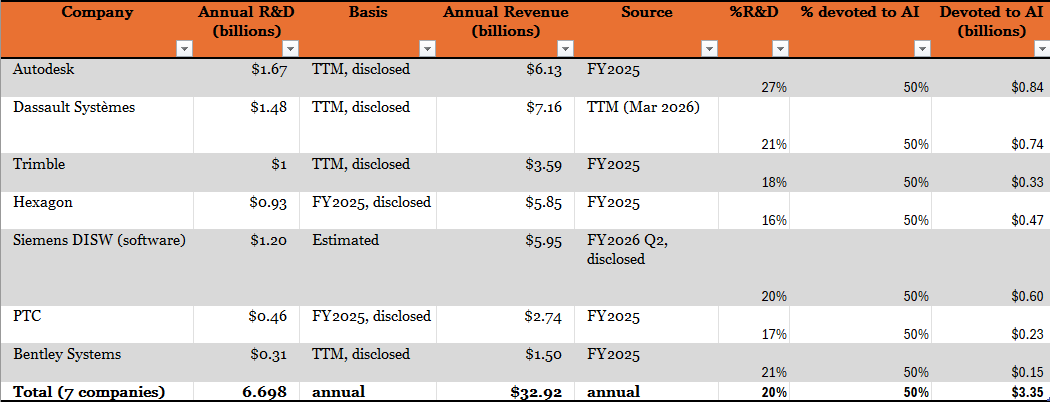
Compare that to the sum total of R&D for design and engineering software, which we’ll estimate to be $7 billion (about 20% of total revenue) and as much as half of that is being spent on AI and you arrive at a total of $3 billion per year being invested by incumbents on AI.
If we say that half of all funding was received in the last year, we see that VC funding for startups is more than 3 times incumbents’ R&D spending.
Someone Is Going to Get This Right
With this much money pouring into AI design and engineering and so many ideas and startups racing to crack the code, somebody is bound to get it right. It doesn’t take all 779 of Finocchiaro’s companies. It takes one.
Project Prometheus, with a war chest north of $18 billion and Jeff Bezos’s backing, could conceivably pull it off alone. That’s more than the combined R&D budgets of Autodesk and Dassault Systèmes, pointed at a single goal: AI that designs like an engineer, not a chatbot playing pretend.
It doesn’t have to be Prometheus. Motif, founded by Amar Hanspal, briefly Autodesk’s own co-CEO before the board chose Andrew Anagnost instead, has raised $46 million to rebuild building design from scratch, cloud-native and unburdened by decades of legacy code. Leo AI, led by the charismatic Maor Farid, raised a comparatively modest $9.7 million but already has 20,000 mechanical engineers using it.
Wake Up, Sleeping Giants
The incumbents ought to sound the alarm, as Sundar Pichai did at Alphabet. Most are still hitting snooze.
Autodesk deserves credit for building something of its own instead of bolting an LLM onto a CAD API. But even if Autodesk changes course tomorrow and adopts NVIDIA’s physical AI, a working AI-based design application is still years away.
The rest of the giants seem content to wait out the storm, confident only they alone know how to make precise shapes, such as Parasolid, the geometry kernel of choice. They forget precise shapes aren’t the only shapes that matter and their geometry kernels choke on organic freeform shapes, point clouds and mesh models; in fact, most of the shapes in the real world. They insist their software is easy to use but only for those who know how to use it. And like every professional software maker, from CAD to simulation to SQL databases, they still insist we learn their language instead of building software that learns ours.
But we know the natural language interface works. Thanks, ChatGPT.
The dinosaurs didn’t have years to adapt to dark skies and cold after the meteor struck. Their world changed quickly. CAD companies don’t have years either.
