

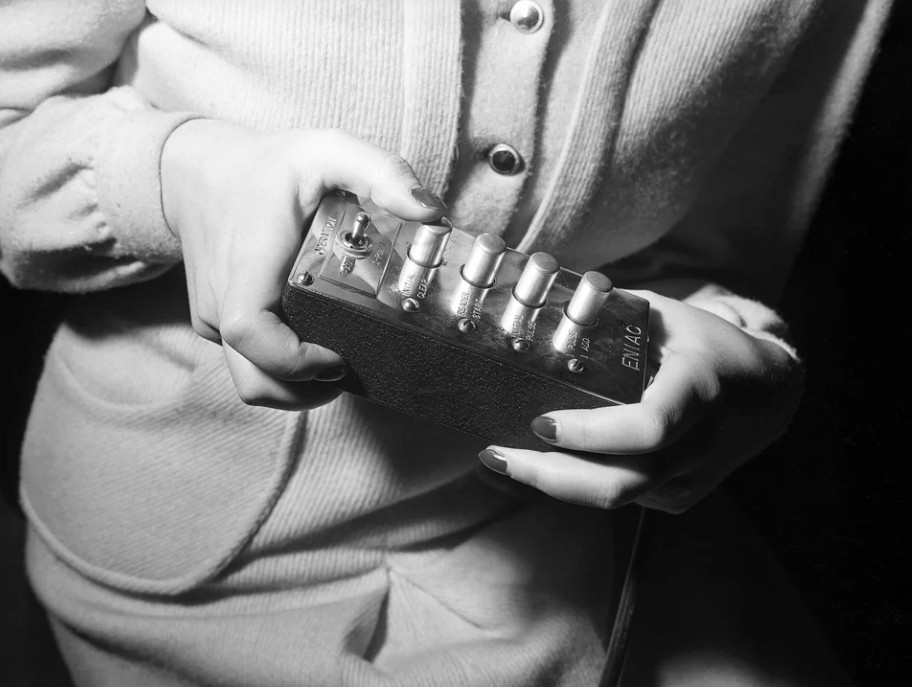
Eighty years after its debut, ENIAC is often remembered as the first general-purpose electronic computer, but a recent reflection in IEEE Spectrum reframes its legacy through a more human lens. Rather than focusing solely on technical achievement, the article highlights the interplay between computation, storytelling, and creativity that shaped the machine’s development.
At the center of this narrative are John Mauchly, ENIAC’s co-inventor, and Kathleen “Kay” McNulty, one of its original programmers. Their shared interests extended beyond engineering. Mauchly was driven by a desire to predict weather patterns, while McNulty saw herself as a storyteller. The article draws on the Irish word ríomh, which can mean to compute, weave, or narrate, to capture the essence of their work.
This metaphor of weaving is especially fitting. Programming ENIAC required physically routing cables and configuring switches, a process that resembled threading a loom. Without manuals or formal programming languages, the early programmers developed an intuitive, hands-on understanding of the machine. They could diagnose faults, anticipate behavior, and even extend its capabilities beyond its original design.
One such innovation was the concept of the subroutine, which emerged from the programmers’ efforts to reuse sequences of instructions. This idea, now fundamental to modern software, was not part of ENIAC’s original blueprint but evolved through experimentation and practical necessity.
The article also emphasizes ENIAC’s role in early weather forecasting, fulfilling Mauchly’s vision of using computation to model complex, time-dependent systems. These models, the author suggests, are essentially structured narratives that describe how systems evolve.
Ultimately, ENIAC’s legacy lies not just in its hardware but in the ways people used it to interpret and shape the world. It marked the beginning of computing as both a technical and creative endeavor, where calculation and storytelling became deeply intertwined.
