

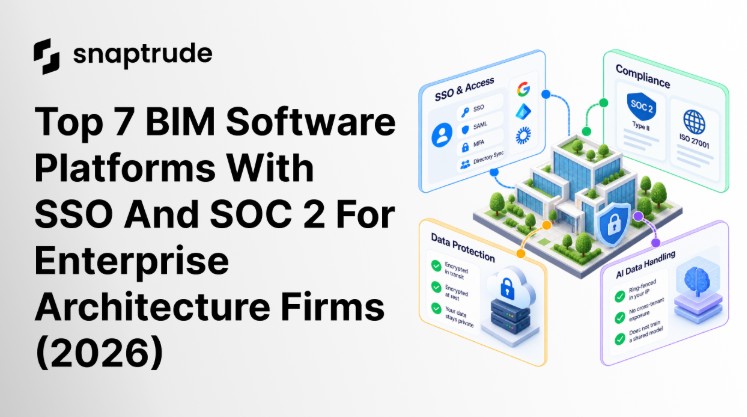
Security has become an important factor in BIM software selection as architecture firms handle sensitive models for hospitals, financial institutions, government facilities, and other major projects. A Snaptrude comparison examines seven design and BIM platforms based on single sign-on, or SSO, SOC 2 compliance, ISO 27001 certification, pricing, and workflow capabilities.
Snaptrude reports SOC 2 Type II compliance and ISO 27001 certification, while its Enterprise plan provides SSO, SAML, multifactor authentication, and directory synchronization. The browser-based platform supports workflows from site studies and massing through constructability documents. Its AI agents can assist with zoning, programming, massing, site analysis, and sketch-to-BIM tasks while keeping generated geometry editable and traceable.
Autodesk Revit remains a strong choice for documentation-intensive projects. Autodesk provides SSO with Revit subscriptions and maintains SOC 2 and ISO 27001 attestations for several AEC cloud services. However, firms should confirm exactly which certifications apply to the cloud services connected to their Revit workflows.
Speckle offers SOC 2 Type II certification and SSO on paid plans. Rather than replacing BIM authoring software, it provides a data and interoperability layer for moving, governing, and checking information across applications.
Allplan stands out for structural and precast detailing, backed by ISO/IEC 27001:2022 certificates associated with its parent company, Nemetschek. Public information about Allplan SSO and SOC 2 support remains limited.
SketchUp, Finch3D, and Giraffe provide SSO for larger or enterprise customers, but the article found no publicly confirmed SOC 2 status for these products. Their strengths also differ: SketchUp targets concept modeling, Finch3D focuses on generative housing layouts, and Giraffe specializes in site feasibility.
The comparison stresses that published security claims should only begin an enterprise review. Architecture firms should request current audit reports and certificates while examining data residency, access controls, AI data handling, and whether customer models or prompts can train shared AI systems.
