

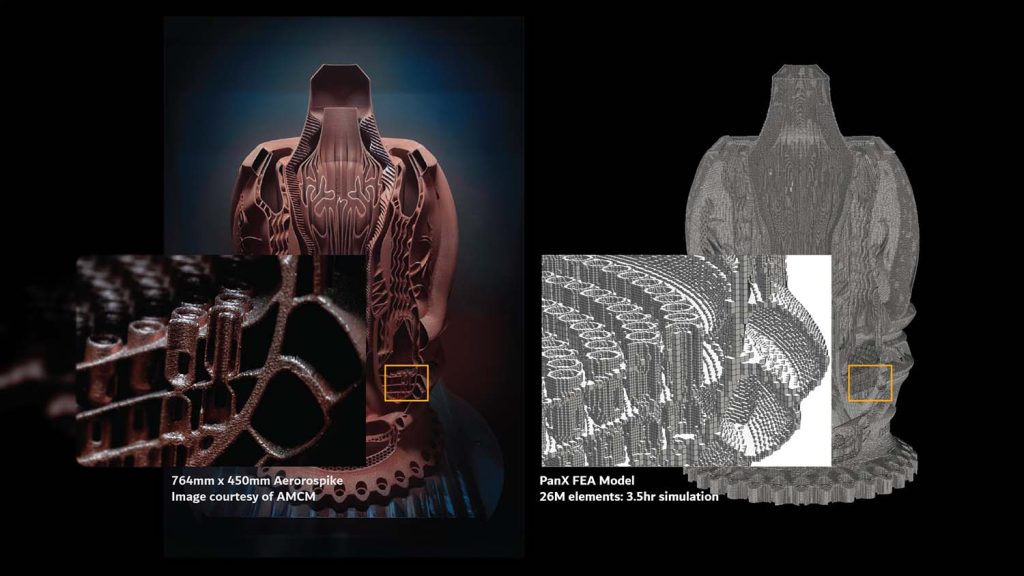
AMCM, the large-format metal 3D printing subsidiary of EOS, has integrated PanOptimization’s PanX simulation software into EOSPRINT. The integration brings physics-based thermomechanical simulation directly into additive manufacturing (AM) build preparation, enabling engineers to identify and address potential manufacturing problems before production begins, says Develop 3D.
The development benefits EOS users across different machine sizes, from M 290-class systems to the AMCM M 8K, which offers a build volume of 800 × 800 × 1,200 mm. For large, complex, and expensive components, predicting thermal behavior is particularly important because excessive heat can compromise dimensional accuracy and part quality.
PanX reads an EOSPRINT .openjz file and extracts build information, including component geometry, build plate layout, and processing parameters. Additional machine-specific information, such as processing time per layer, is transferred through the EOSPRINT API. This eliminates repetitive setup tasks, improves simulation accuracy, and reduces turnaround times from days to hours.
Once simulation is complete, optimized dwell times, compensated geometries, and adjusted laser powers are automatically written back into the build file. These changes can then be implemented directly on the printer, making simulation more accessible to design and manufacturing engineers without requiring dedicated simulation expertise.
AMCM demonstrated the technology on a large M 8K build, highlighting the problems caused by localized heat accumulation. These include distortion, residual stress, internal defects, partially sintered powder, and difficult depowdering. Thermal simulation identifies hotspots before printing, allowing engineers to adjust build strategies and prevent quality issues.
PanOptimization emphasizes that conventional density and tensile testing cannot fully address problems dependent on component geometry and thermal history.
The integration represents a shift toward simulation-driven metal AM, where manufacturing decisions are informed by physics-based predictions rather than repeated physical trials. For manufacturers producing high-value components, this approach offers greater process predictability, improved repeatability, and stronger support for part qualification.
