

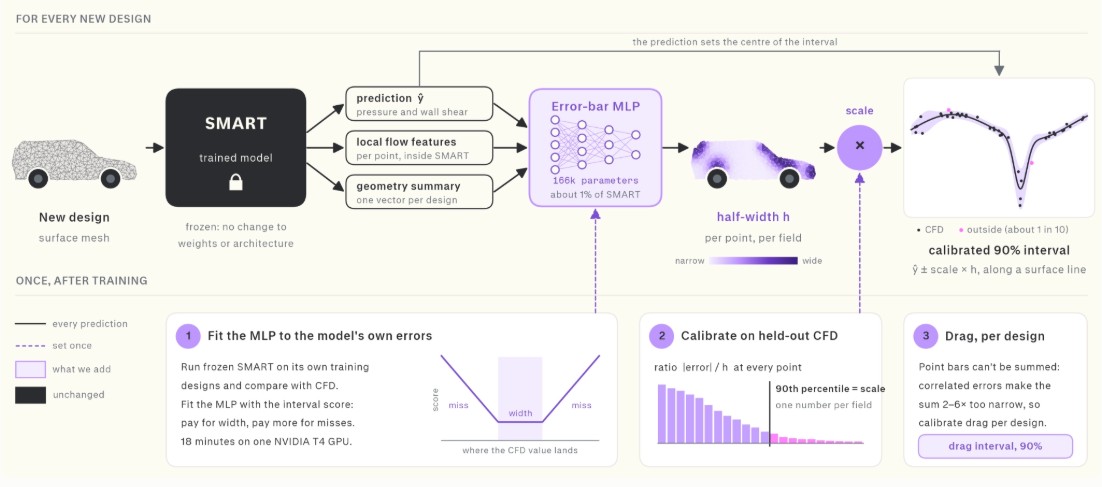
Luminary is addressing a critical challenge for Large Physics Models, or LPMs: determining how much engineers should trust each prediction. Its uncertainty quantification method adds calibrated error bars to predictions, helping users understand the likely difference between an LPM result and a computational fluid dynamics result.
LPMs can predict surface physics fields for new designs in minutes, compared with hours for CFD simulations. Speed alone, however, does not reveal whether a prediction is accurate. Uncertainty quantification provides error estimates at individual surface points and for integrated quantities such as drag and lift. Engineers can use these estimates to compare closely matched designs, identify potentially high local loads, target areas requiring CFD verification, and reject optimization candidates whose predicted improvements fall within the model’s uncertainty.
Traditional approaches such as deep ensembles and Monte Carlo dropout require multiple models or repeated inference passes. They can increase training and inference costs and cannot easily be added to an already trained model. Luminary instead keeps the original LPM unchanged and adds a companion network with about 166,000 parameters. The network learns the typical size of prediction errors using the LPM’s internal flow features, geometry information, and predictions.
Luminary then calibrates the error bars using held-out CFD simulations and normalized split conformal prediction. In tests on the SHIFT-SUV dataset, 90% error bars contained CFD values at exactly 90% of surface points. Tests involving SHIFT-Wing, SHIFT-Truck, and DrivAerML also showed that uncertainty increased in physically difficult regions, including shocks, mirrors, wheel arches, and areas with flow separation.
The approach complements Luminary’s out-of-distribution detection. Designs unlike the training data can first be flagged for CFD analysis, while uncertainty quantification evaluates predictions for familiar designs. Together, the methods give engineers a clearer basis for deciding when Physics AI is reliable and when higher-fidelity simulation remains necessary.
