

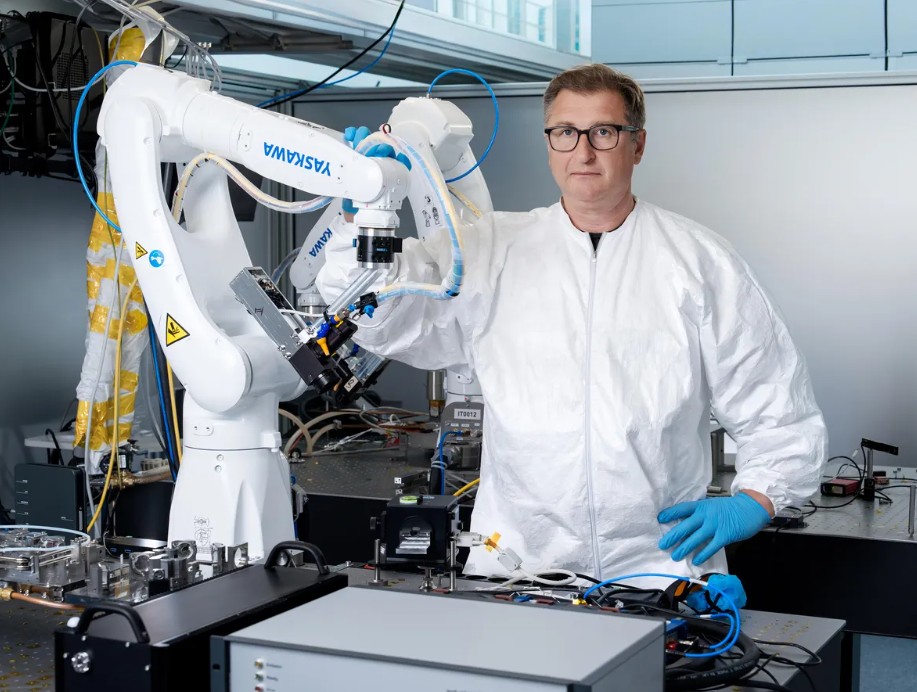
Europe’s push for technological independence is creating opportunities for ultrafast laser startups. Supported by European Union funding and growing commercial demand, companies are developing laser systems for advanced semiconductor manufacturing, optical communications, and quantum technologies, tells IEEE Spectrum.
Ultrafast lasers generate extremely short pulses of light, measured in femtoseconds or picoseconds. Their precision enables manufacturers to process delicate materials without damaging surrounding areas through excessive heat. These capabilities are increasingly important for semiconductor miniaturization and advanced chip packaging.
One application involves drilling microscopic through-glass vias in interposers, which connect stacked chiplets. These holes are subsequently filled with copper to establish electrical connections. Other applications include wafer dicing and printed circuit board probe cards.
Lithuanian startup Litilit is preparing to establish a new manufacturing facility in October 2026. Meanwhile, Germany’s RayVen Laser is developing two product lines at pilot scale, supported by additional EU funding received in April. The company is working with universities on demonstrator systems for semiconductor processing.
RayVen also sees opportunities in photonic integrated circuits and copackaged optics, technologies that could improve data transmission and computing efficiency.
Switzerland-based Menhir Photonics is pursuing another application through miniature femtosecond lasers operating at a 1.5-micrometer wavelength. Its technology provides precise synchronization for telecommunications networks, with potential applications in 6G, quantum systems, and AI data centers.
Market estimates place the global ultrafast laser industry at approximately $2.4 billion in 2025, with projected annual growth of around 20%.
However, industry experts question whether European funding alone can establish technological independence. Semiconductor manufacturing still depends on equipment and components sourced internationally. Commercial scalability and sustained customer demand remain essential.
For engineers and manufacturers, the developments highlight the expanding role of precision photonics in semiconductor fabrication, high-speed connectivity, and next-generation computing infrastructure. Europe’s emerging laser companies are positioning themselves within these increasingly important industrial supply chains.
