

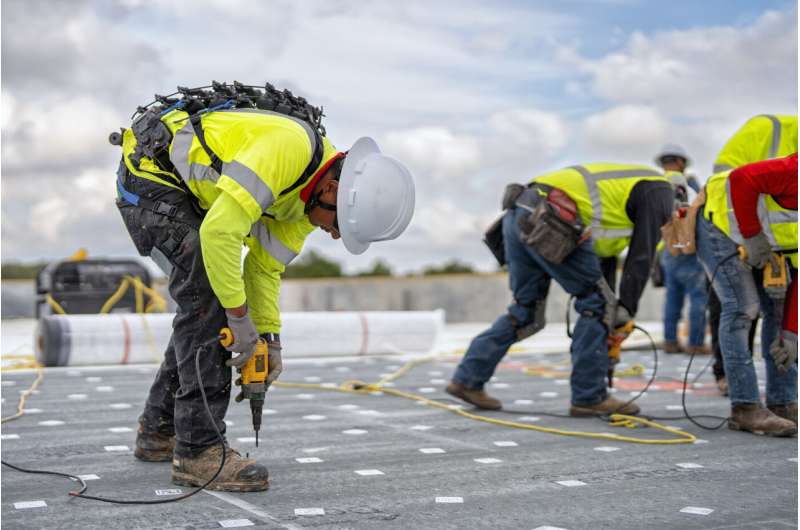
Construction exoskeletons could improve workplace safety by reducing physical fatigue and helping workers remain alert to potential hazards. Researchers at Texas A&M University found that wearing a passive lower-back exoskeleton reduced fatigue by 37% while improving hazard recognition performance by 29%. The findings suggest that wearable support devices may benefit both physical endurance and cognitive awareness on construction sites, tells Tech Xplore.
The field study involved 16 construction workers who completed three-hour sessions performing their regular duties with and without an exoskeleton. Researchers measured fatigue and evaluated participants’ ability to identify hazards and assess risks using construction-site images before and after each session.
The results revealed a relationship between physical exertion and situational awareness. Workers experiencing smaller increases in fatigue generally demonstrated greater improvements in hazard recognition. Reducing physical strain may therefore free up cognitive resources, allowing workers to concentrate on their surroundings and identify potential dangers.
Unlike powered systems, passive exoskeletons provide mechanical support without requiring motors. Such devices can assist different body regions, including the back, arms, and knees.
Although exoskeletons are increasingly used in automobile manufacturing, logistics, and warehousing, construction presents additional challenges. Workers frequently transition between different activities, making it difficult to design wearable systems that accommodate varied movements and working conditions.
Associate professor Chukwuma Nnaji emphasizes that exoskeletons should complement existing safety practices rather than replace them. Construction companies should prioritize eliminating hazards through better work design before introducing wearable technologies to reduce unavoidable physical demands.
The research team continues to evaluate exoskeletons in real construction environments, collaborating with industry partners and workers to improve device design and deployment.
The study broadens the potential role of exoskeletons beyond musculoskeletal support. By addressing the connection between physical fatigue and cognitive performance, wearable technology could contribute to safer construction environments where workers must continuously recognize and respond to changing hazards.
