

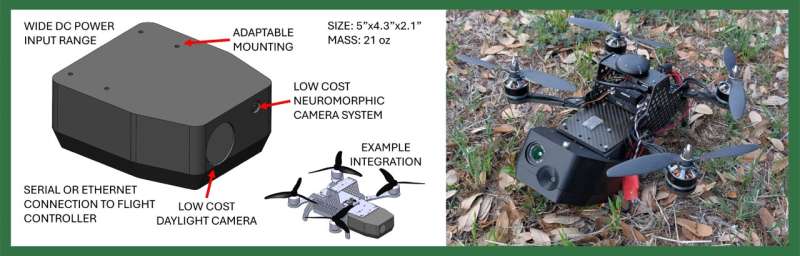
Southwest Research Institute has developed a drone-mounted detection system that uses eye-inspired cameras to identify fast-moving unmanned aerial systems in complex environments. Called Hierax, the system combines event-based neuromorphic cameras with custom software for autonomous drone detection and tracking, tells Tech Xplore.
Unlike conventional optical cameras, which capture complete images as a sequence of frames, neuromorphic cameras respond to changes in brightness at individual pixels. The approach resembles aspects of biological vision and allows the sensor to react quickly to movement without continuously processing complete images.
SwRI researchers see this capability as particularly useful for counter-UAS applications. Hierax could potentially turn different types of drones into autonomous interceptors capable of detecting, tracking, pursuing, and neutralizing rogue or hostile aircraft without continuous manual piloting.
Current drone-detection technologies include radar, radio-frequency sensing, acoustics, thermal imaging, and conventional optical cameras. Event-based cameras offer another option because they operate passively and do not emit signals that adversaries can jam. They can also reduce size, weight, power consumption, and cost, important considerations for systems carried aboard small drones.
Another advantage is computational efficiency. According to SwRI, its neuromorphic approach requires less computing power than conventional optical systems that depend on more complex machine-learning processing. Event-based cameras have been studied in laboratories for decades, but researchers are increasingly adapting them for real-world environments where lighting, backgrounds, movement, and multiple objects complicate detection.
SwRI designed Hierax using a modular open systems approach aligned with U.S. Department of Defense interoperability requirements. This hardware-agnostic strategy is intended to allow the imaging and interception technology to work with different drone platforms and accommodate future hardware upgrades without dependence on a single vendor.
The project demonstrates the growing potential of neuromorphic sensing for autonomous aerial systems, particularly applications requiring rapid visual response, low computing demands, and reliable operation in contested environments.
