

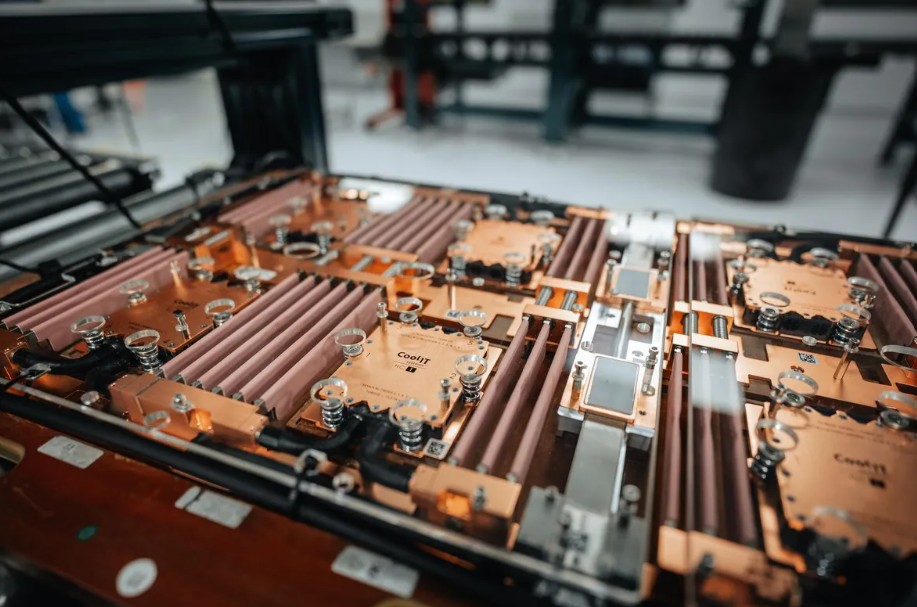
Artificial intelligence is pushing server cooling systems toward their limits as increasingly powerful processors generate unprecedented heat. CoolIT, an Ecolab company, is developing fanless liquid-cooling solutions designed to capture nearly all the heat produced by high-density AI servers, tells IEEE Spectrum.
Traditional server cooling combines liquid and air, with liquid handling processors and fans cooling surrounding components. However, rising processor thermal design power (TDP) is increasing temperatures across memory, networking, storage, and power systems. These components now require dedicated cooling solutions rather than relying on airflow.
CoolIT argues that hybrid cooling becomes impractical beyond approximately 250 kilowatts per rack. A conventional 70/30 liquid-to-air cooling arrangement leaves 75 kilowatts of heat for air cooling, requiring substantial additional infrastructure. Near-total liquid heat capture reduces the remaining air load to less than 1%, making fanless server designs possible.
Achieving this requires more than cooling CPUs and GPUs. Peripheral components have different geometries, mounting requirements, and thermal limits. CoolIT addresses these variations through conductive plates, vapor chambers, heat pipes, thermal transfer plates, and specialized coldplates for pluggable components.
These technologies transfer heat into a unified liquid-cooling loop that distributes coolant throughout the server. The company uses modular coldplate building blocks developed across six generations of fanless designs, emphasizing reliable connections, efficient coolant routing, and simplified assembly.
As AI rack power approaches one megawatt, cooling infrastructure must accommodate increasingly concentrated thermal loads. CoolIT’s modeling suggests that near-total liquid heat capture could become standard in flagship rack-scale systems through 2028.
Although achieving exactly 100% heat capture is practically impossible, reducing residual air cooling below 1% represents a significant engineering milestone.
The approach could reduce dependence on server fans and parallel air-cooling infrastructure while supporting denser computing installations. For data center engineers, the development highlights a shift toward treating thermal management as an integrated server-design requirement rather than an isolated processor-cooling problem.
