

Engineers at the University of Pennsylvania have developed Fast Feature Field, or F³, a computational framework designed to make event cameras more practical for robots, tells Tech Xplore. Event cameras mimic aspects of biological vision by detecting changes in light continuously instead of capturing complete images at fixed intervals. This enables rapid responses to motion and difficult lighting, but their streams of millions of individual events have traditionally required specialized processing for each application.
F³ addresses this limitation by creating a general-purpose representation of event-camera data. The researchers initially explored mathematical signal-processing techniques but found them unable to efficiently capture both scene structure and motion. They instead trained a neural network to predict future events from previous ones. To make accurate predictions, the AI learns representations that encode what is present in a scene and how it is moving.
Efficiency presented another challenge. Although event cameras can generate tens of millions of signals per second, about 95% of possible data positions contain no events at a given moment. F³ exploits this sparsity by performing calculations only where events occur rather than processing empty space.
Researchers tested F³ on object recognition, distance estimation, and motion tracking using data from cars, quadruped robots, and drones operating in conditions ranging from nighttime streets to crowded interiors. F³-based approaches achieved state-of-the-art results on several perception tasks while running approximately two to five times faster than previous methods. The system processed high-definition event-camera data at 120 times per second and lower-resolution VGA data at 440 times per second.
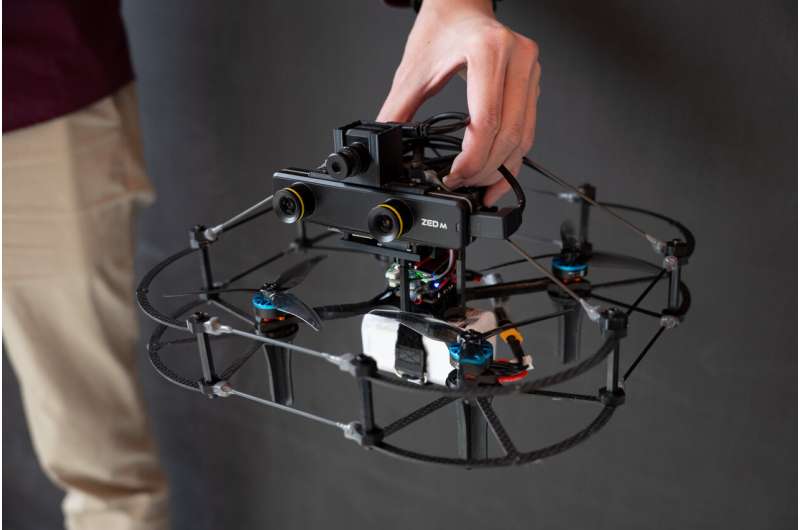
The technology could provide a bridge between event cameras and existing computer-vision software, reducing the need to develop task-specific processing systems. Researchers are already incorporating F³ into autonomous drones for navigation through cluttered, poorly lit environments. Eventually, they envision integrating the technology directly into event-camera hardware, potentially making these sensors easier to deploy in drones, autonomous vehicles, and other fast-moving robotic systems.
