

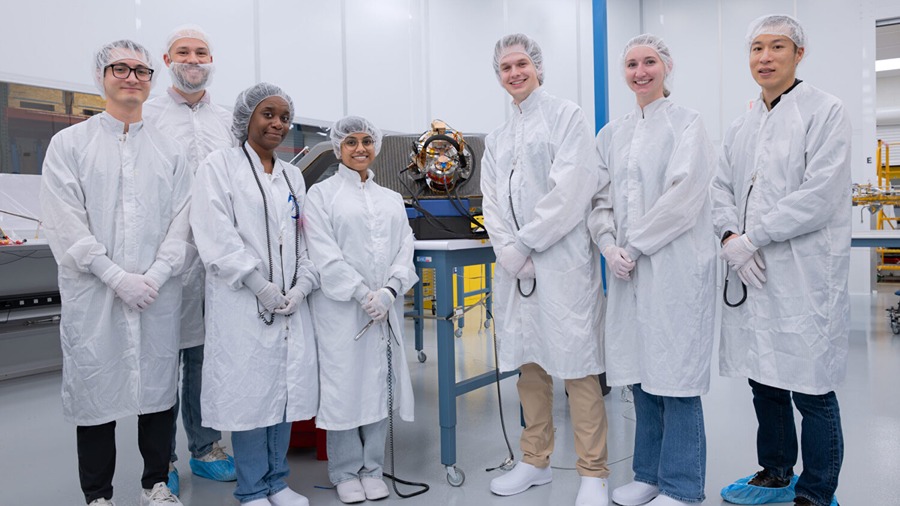
CEDAR PARK, TX, Apr 10, 2026 – Firefly Aerospace is working with NVIDIA to enable on-orbit processing in lunar orbit for its Ocula Moon imaging service. An NVIDIA Jetson module has been integrated with telescopes from Lawrence Livermore National Laboratory, delivered to Firefly’s spacecraft facility for installation on the Elytra orbital vehicle.
“Ocula is set to be the first commercial lunar imaging and mapping service available on the market, and it’s coming at a critical time when other government-owned satellites in lunar orbit are nearing end of life,” said Jason Kim, CEO of Firefly Aerospace. “Now through our collaboration with NVIDIA, Ocula will be powered by the world’s leading edge AI processor. This capability allows us to layer on our SciTec AI software as the ‘brains’ that give customers real-time data driven insights from the Moon.”
Firefly will activate Ocula imaging service on Elytra during Blue Ghost Mission 2, targeted for launch in late 2026. Elytra will first operate as a transfer vehicle and communications relay for the Blue Ghost lander, then remain in lunar orbit for about five years to capture continuous imagery for surface mapping, mineral detection, and reconnaissance.
Firefly will process Ocula data onboard Elytra and transmit it to Earth using an NVIDIA Jetson module integrated with Firefly’s AI software from its SciTec subsidiary. The onboard processing reduces the volume of data sent from the Moon by analyzing imagery before transmission to Earth for government and commercial customers.
“Modern space missions generate massive volumes of data that require immediate processing to overcome the latency and bandwidth constraints of deep-space communications,” said Deepu Talla, vice president of Robotics and Edge AI at NVIDIA. “Integrating the NVIDIA Jetson platform into Firefly’s Elytra spacecraft enables autonomous, on-orbit AI processing that transforms raw lunar imagery into actionable insights in real time.”
Firefly’s AI software will process multiple onboard data streams to track maneuvering objects and report activity in lunar orbit. These AI algorithms and data fusion methods, previously used in national security missions in Earth orbit, extend monitoring to the cislunar domain.
Following Blue Ghost Mission 2, Firefly is on contract to deploy two additional Elytra vehicles during Blue Ghost Mission 3 and Mission 4. These missions will increase revisit frequency for lunar mapping, resource detection, and space domain monitoring.
Source: Firefly Aerospace
About Firefly Aerospace

Firefly Aerospace, headquartered in Cedar Park, TX, develops launch vehicles, lunar landers, and in-space transport systems for commercial and government clients in the aerospace and defense sectors. Founded in 2017, the company provides small- and medium-lift rockets, lunar lander missions, and satellite deployment support for orbital and deep-space operations. Its customers include government space agencies, defense organizations, and commercial satellite operators.
About NVIDIA

NVIDIA, founded in 1993 and headquartered in Santa Clara, CA, designs and manufactures graphics processing units, systems on chips, networking hardware, and AI intelligence software such as CUDA. Its products serve industries including gaming, data centers, autonomous vehicles, professional visualization, robotics, health care, and energy. The company introduced the GPU in 1999 and later expanded into accelerated computing and AI infrastructure. In gaming, its GPUs support high-performance rendering, while in AI and high-performance computing, its systems provide the infrastructure for training and deploying large-scale models. NVIDIA also develops tools for robotics and autonomous driving.
