

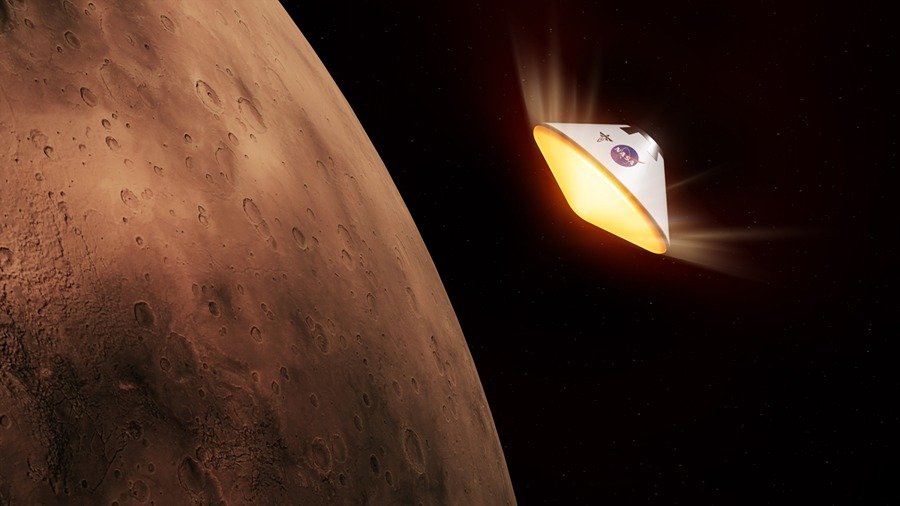
CEDAR PARK, TX, July 13, 2026 – Firefly Aerospace will build the aeroshell, including the backshell and heatshield, for NASA’s SkyFall Mars mission, a late-2028 JPL-managed flight that will release three helicopters during descent for surface imaging, subsurface radar mapping and water ice scouting.
The work comes under a $13 million subcontract from NASA’s Jet Propulsion Laboratory (JPL). Firefly will develop the aeroshell at its Gloworks innovation lab and manufacture it at the company’s Rocket Ranch in Briggs, Texas.
“NASA’s SkyFall is Firefly’s first award coming out of our new Gloworks innovation lab, which embodies our commitment to developing disruptive space technologies without disrupting our existing production lines,” said Shea Ferring, chief technology officer at Firefly Aerospace. “Our deep expertise in building large composite structures for both spacecraft and rockets gives us a unique advantage to enable critical planetary missions like SkyFall. We’re further innovating these core technologies through Gloworks to push the boundaries of what’s possible and open new frontiers across our solar system.”
Firefly will use carbon composite technologies from its Blue Ghost lunar landers, Elytra orbiters, and Alpha and Eclipse launch vehicles to produce lightweight structures for the mission.
After manufacturing, Firefly will conduct structural qualification and flight acceptance testing at Rocket Ranch. The tests will cover mission requirements for launch, cruise, and Mars entry, descent and landing environments. Firefly will then deliver the aeroshell to JPL for additional environmental testing before integration with the SkyFall helicopters and deployment system.
SkyFall will use a mid-air release technique called the “SkyFall Maneuver”. An entry capsule will release the three helicopters during descent, removing the need for a landing platform. The helicopters will fly to the surface and collect high-resolution surface imagery and subsurface radar data. JPL will use the data to study the landing site terrain, examine natural forces that shaped the landing site and scout for water ice.
“Firefly is ready to support the next generation of Mars exploration with a new level of speed and affordability,” said Ray Allensworth, vice president of Spacecraft at Firefly Aerospace. “We’ve proved our ability to execute off-Earth missions at a fraction of the cost and timeline through our successful Blue Ghost lunar mission. Now we’re applying these lessons learned and utilizing our proven technologies to continue accelerating and lowering costs for future missions to the Moon, Mars, and beyond. Everything we’re doing on the Moon yields transferrable technologies and experience that we can apply to Mars.”
Firefly also has four upcoming lunar missions under NASA’s Commercial Lunar Payload Services (CLPS) initiative. The company received another JPL subcontract to deliver four drones above the lunar south pole with its Elytra spacecraft for NASA’s MoonFall mission.
The company recently doubled the size of its central Texas facilities and expanded its spacecraft cleanroom to support an assembly line for lunar landers and orbital vehicles.
Source: Firefly Aerospace
About Firefly Aerospace

Firefly Aerospace, headquartered in Cedar Park, TX, develops launch vehicles, lunar landers, and in-space transport systems for commercial and government clients in the aerospace and defense sectors. Founded in 2017, the company provides small- and medium-lift rockets, lunar lander missions, and satellite deployment support for orbital and deep-space operations. Its customers include government space agencies, defense organizations, and commercial satellite operators.
