

Researchers have developed a new glass-based material that could improve the quality and safety of X-ray imaging while offering a level of flexibility not found in conventional scintillators. The innovation, reported in ACS Energy Letters, centers on a moldable glass that converts X-rays into visible light more efficiently, enabling sharper images at lower radiation doses, tells Tech Xplore.
Scintillators play a critical role in medical imaging by transforming incoming X-rays into light that can be detected and processed into images. Traditional scintillators are often limited by either performance or form factor. To address these limitations, researchers led by Osman Bakr and Mehmet Bayindir created a new “quantum glass” by embedding nanoclusters composed of copper, iodine, and organic molecules into a glass matrix. This hybrid structure combines some of the advantages of crystalline scintillators with the flexibility and manufacturability of glass.
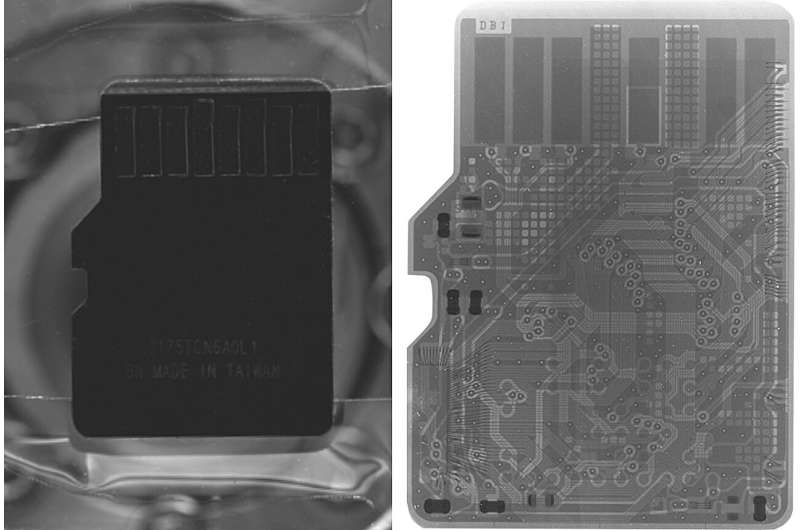
The new material demonstrated excellent imaging performance in laboratory tests. When used to scan objects such as a memory card and an insect, it revealed fine structural details with high clarity. Because the material converts X-rays into visible light more effectively, imaging systems can operate with lower radiation exposure while maintaining image quality. This feature could be particularly valuable in medical settings, where reducing patient exposure remains a key objective.
One of the most notable characteristics of the material is its ability to become moldable at relatively low temperatures, around 107°F (42°C). Once softened, it can be shaped into curved forms without losing its imaging capabilities. This property may allow future X-ray detectors to better conform to the contours of the human body, potentially improving patient comfort during imaging procedures such as mammography.
The researchers also demonstrated the material’s effectiveness underwater. Images of a fish tail captured in water were nearly as clear as those taken in air, highlighting the scintillator’s potential for specialized imaging applications. By combining flexibility, high resolution, and reduced radiation requirements, the new quantum glass could help advance the next generation of medical and industrial X-ray technologies.
