

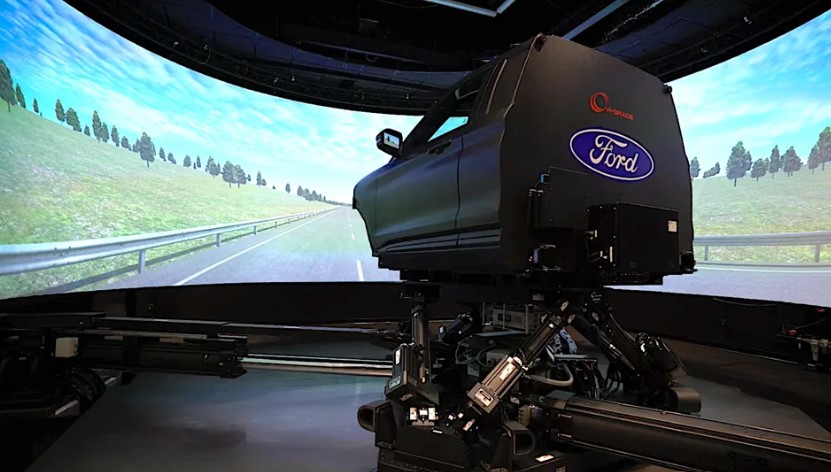
Ford is using an advanced Dynamic Driving Simulator (DDS) to dramatically shorten vehicle development cycles, allowing engineers to evaluate and refine vehicle behavior in a fraction of the time required by traditional testing methods. The system combines real-world driving dynamics, virtual environments, and human feedback to help engineers assess vehicle performance long before physical prototypes are fully developed, tells Design News.
Located at Ford’s engineering facilities, the simulator places a driver inside a realistic cockpit mounted on a motion platform capable of reproducing the sensations of acceleration, braking, cornering, and road surface changes. Surrounding displays generate immersive virtual driving environments that replicate highways, city streets, test tracks, and challenging road conditions. The result is a highly realistic driving experience that enables engineers to gather valuable data without leaving the laboratory.
One of the simulator’s most significant advantages is speed. Engineers can evaluate vehicle characteristics that would normally require months of track testing within a single day. Design changes can be implemented digitally and tested almost immediately, eliminating the delays associated with building new hardware prototypes. This capability is especially valuable as vehicles become increasingly complex, incorporating advanced driver assistance systems, electrified powertrains, and software-defined features.
The simulator also supports collaboration across engineering disciplines. Chassis, steering, suspension, braking, and software teams can evaluate the impact of design changes simultaneously, helping identify potential issues early in development. Because testing occurs in a controlled virtual environment, engineers can repeatedly examine specific scenarios and compare alternative configurations with a level of consistency difficult to achieve on public roads or test tracks.
In addition to reducing development time, the DDS helps lower costs by decreasing reliance on physical prototypes and extensive track testing. It also allows engineers to expose vehicles to rare or hazardous situations that would be difficult, expensive, or unsafe to reproduce in the real world.
Ford views simulation as an increasingly important component of future vehicle engineering. By combining advanced modeling, motion systems, and human-in-the-loop testing, the company is creating a development process that is faster, more efficient, and better suited to the demands of modern automotive design.
