

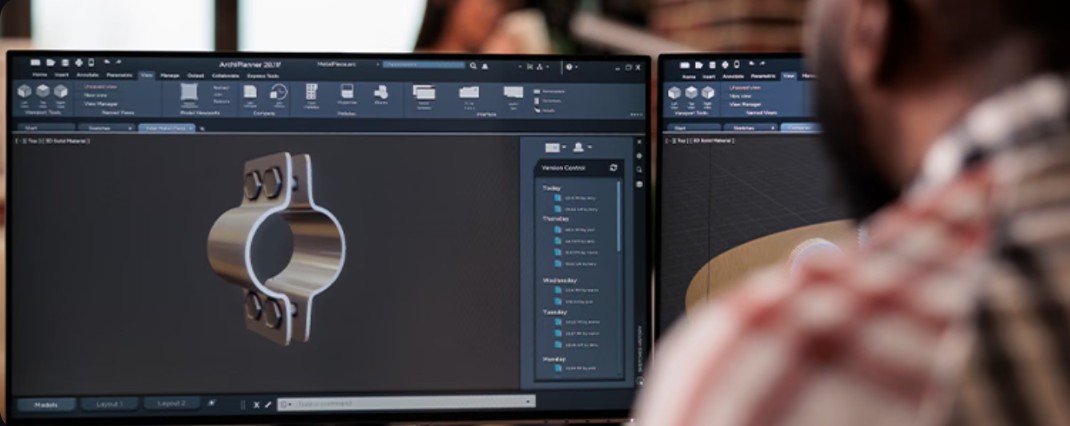
Selecting mechanical components involves evaluating dimensions, material properties, load conditions, manufacturing standards, and supplier availability. Manual calculations and catalog searches can consume valuable engineering time, particularly when teams must coordinate information across CAD, product data management (PDM), and product lifecycle management (PLM) systems.
Leo AI examines four platforms designed to automate component sizing and selection: Leo AI, KISSsoft, Ansys Mechanical, and Siemens NX. Each addresses different engineering requirements, from intelligent part searches to structural validation and manufacturing integration.
Leo AI uses natural language queries to search more than 120 million vendor components alongside internal engineering databases. Its AI-powered calculations and PDM integration help engineers identify suitable parts, compare specifications, and reduce bill of materials (BOM) preparation time. The company reports that users save more than 8.3 hours per engineer weekly.
KISSsoft specializes in standards-based calculations for gears, shafts, bearings, and related machine elements. Supporting ISO, DIN, and AGMA standards, it helps engineers validate component dimensions and optimize gearbox designs.
Ansys Mechanical uses finite element analysis (FEA) to evaluate structural performance under mechanical and thermal loads. Python scripting, Ansys Parametric Design Language (APDL), and customization tools support automated simulations, parameter studies, and design optimization.
Siemens NX combines CAD, computer-aided engineering (CAE), and computer-aided manufacturing (CAM) capabilities. Its generative design tools and Part Families functionality support component variations and integrated design-to-manufacturing workflows.
The article recommends evaluating platforms according to engineering accuracy, component libraries, standards compliance, CAD compatibility, and the transparency of automated recommendations.
Parametric modeling, configurable component libraries, and integrated calculation tools are particularly valuable for reducing repetitive work.
Ultimately, successful automation depends on matching software capabilities to engineering requirements. Rather than replacing professional judgment, these platforms help engineers make faster, better-informed component selection decisions while maintaining design quality and technical compliance.
