

TAIPEI, Taiwan (NVIDIA GTC), June 12, 2026 – Foxconn and medical centers in Taiwan are deploying AI agent systems powered by NVIDIA across hospitals to coordinate clinical workflows, documentation, logistics and robotic support.
The deployments focus on agentic AI systems to coordinate clinical and operational work across hospitals. Specialized agents are domain-specific, always-on AI systems that reason, plan and act across digital and physical workflows. Digital agents operate inside hospital systems to support clinical reasoning, documentation and care coordination. Physical agents, including robots and intelligent devices, work on hospital floors to support logistics, monitoring and procedures.
Under the Taiwan government’s “Healthy Taiwan” initiative, the region has committed $1.5 billion to build an AI-native health system spanning hospitals, academic institutions and companies. Foxconn will serve as the ecosystem integrator connecting government programs, hospitals, device makers and software companies for clinical AI deployments.
“The next era of healthcare is being powered by agentic AI – teams of digital and physical AI agents working alongside clinicians,” said Kimberly Powell, vice president of healthcare at NVIDIA. “Together with Foxconn and Taiwan’s leading medical centers, NVIDIA is accelerating the deployment of AI infrastructure that helps clinical teams, improves hospital efficiency and creates a model for health systems around the world.”
An AI Team for Every Clinician
Foxconn’s CoDoctor platform brings together AI agents for cardiovascular care, oncology and ophthalmology. The system is designed to help clinicians review diagnoses, manage documentation and coordinate care across departments.
New agents within CoDoctor AI include:
- ECG AI Agent: An AI-based EKG screening system that helps hospitals triage patients efficiently.
- Corovia AI Agent: An AI-assisted solution that automatically reconstructs the heart and coronary arteries in 3D, reducing a two-hour clinical workflow to one minute.
- Endovia AI Agent: An AI-powered colonoscopy solution that supports lesion detection and AI-assisted clinical workflows with millisecond-level edge inference.
NVIDIA Nemotron open models provide clinical reasoning and multimodal capabilities for digital specialized agents. Their open weights give healthcare institutions control over their models.
Foxconn also introduced CoDoClaw, a clinical agent system built on NVIDIA NemoClaw, an open-source blueprint for deploying autonomous agents, with NVIDIA OpenShell for privacy and security controls. CoDoClaw extends CoDoctor AI from AI tools into a multi-agent orchestration platform that can coordinate agents for breast cancer screening, ECG analysis, fundus imaging and coronary artery analysis through a clinical interface.
The agents are being deployed across Taiwan’s medical centers for ECG screening for cardiac conditions, cancer subtype classification, surgical planning and real-time diagnostic support during procedures such as colonoscopy.
Special Agents in the Physical World
Foxconn’s Scrub Bot, an AI-enhanced scrub nurse robot, is operating in live surgical suites, where it responds to surgeon voice commands and adapts to changing needs.
NVIDIA offerings such as the Agent-Ready Rheo blueprint within NVIDIA Isaac for Healthcare support the development of hospital automation workflows. Foxconn is using Rheo to automate simulation-to-real pipelines, from scene reconstruction to policy training, evaluation and deployment.
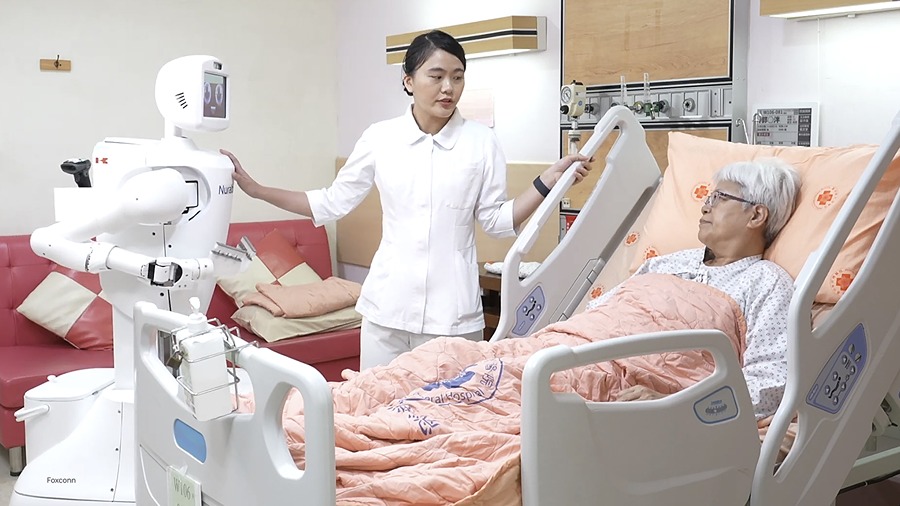
Foxconn’s Nurabot, a nursing robot powered by NVIDIA’s physical AI stack, has been introduced into hospitals, including Taipei Veterans General Hospital and Tungs’ Taichung MetroHarbor Hospital, as well as long-term care settings and overseas nursing education institutions.
By handling transport and logistics tasks, Nurabot frees an estimated two to three hours per day for nurses to focus on patient care. Foxconn is also piloting NVIDIA NemoClaw and NVIDIA physical AI technologies in future Nurabot deployments to improve collaboration and clinical workflow support, and to accelerate the path from simulation to care.
Foxconn first builds NVIDIA Omniverse-powered digital twins of hospital facilities – virtual replicas where AI and robotic systems are tested, trained and validated before they enter clinical settings. This simulation-first approach has reduced deployment time by 40% and enabled 98% navigation accuracy, creating a safer and faster path from development to care.
“Foxconn is building the AI infrastructure and clinical platforms to connect hospitals, medical devices and software innovators across Taiwan,” said Barry Chiang, president of B group and Digital Health at Foxconn. “With NVIDIA technologies across accelerated computing, simulation, edge AI and robotics, we are helping healthcare providers move from proof of concept to scalable, safe deployments that can improve care delivery.”
A Blueprint for AI-Driven Healthcare
Taiwan’s AI healthcare ecosystem includes 85 FDA- or TFDA-cleared medical AI solutions, with every major medical center engaged in AI research or clinical trials.
A majority of Taiwan’s medical centers operate AI systems in daily workflows. Active deployments span Chang Gung Memorial Hospital, Kaohsiung Medical University Chung-Ho Memorial Hospital, MacKay Memorial Hospital, National Taiwan University Hospital, Taichung Veterans General Hospital, Taipei Veterans General Hospital and other care sites – a network handling more than 14 million patient encounters annually.
“Taiwan’s investment in AI-powered medical technology is driving real improvements in how we deliver care to our citizens,” said Dr. Chung-Liang Shih, Minister of Taiwan’s Ministry of Health and Welfare. “Healthy Taiwan is already transforming hospitals and improving outcomes for millions of patients across the country. This is an actionable model that demonstrates what is possible when government, industry and healthcare providers work together toward a shared vision.”
The deployments under “Healthy Taiwan” provide a model for countries building AI-native health systems on NVIDIA infrastructure.
Source: NVIDIA
About NVIDIA

NVIDIA, founded in 1993 and headquartered in Santa Clara, CA, designs and manufactures graphics processing units, systems on chips, networking hardware, and AI intelligence software such as CUDA. Its products serve industries including gaming, data centers, autonomous vehicles, professional visualization, robotics, health care, and energy. The company introduced the GPU in 1999 and later expanded into accelerated computing and AI infrastructure. In gaming, its GPUs support high-performance rendering, while in AI and high-performance computing, its systems provide the infrastructure for training and deploying large-scale models. NVIDIA also develops tools for robotics and autonomous driving.
About Foxconn

Foxconn is a multinational electronics manufacturer headquartered in Tucheng District, New Taipei City, Taiwan. Founded in 1974, it is recognized as the world’s largest electronics contract manufacturer. The company provides services in electronics manufacturing, component production, and assembly for global technology brands. Foxconn’s operations span across industries including consumer electronics, computing, telecommunications, automotive, and healthcare. It produces devices such as smartphones, laptops, tablets, and gaming consoles. The company operates manufacturing facilities in China and the U.S. Foxconn is expanding into EVs, semiconductors, and AI to drive long-term growth.
