

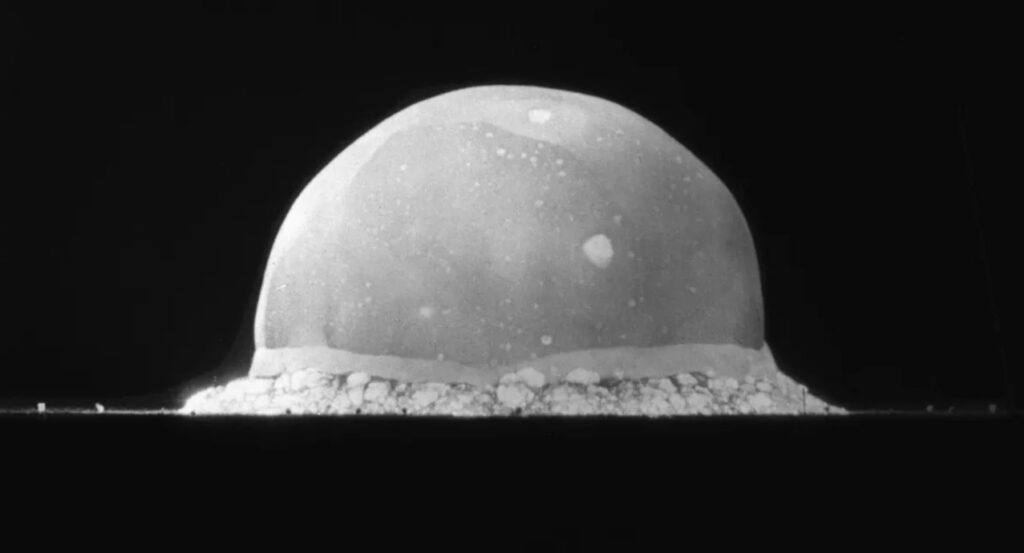
An article in IEEE Spectrum examines a newly released book that revisits the Trinity test, the first detonation of a nuclear weapon in human history. Titled Trinity, the book gathers roughly 350 restored images from the Manhattan Project archives, offering an unusually intimate visual account of the July 16, 1945, explosion in the New Mexico desert.
The article centers on author Emily Seyl, a writer and editor at Los Alamos National Laboratory’s National Security Research Center. Seyl explains that the project originated from a decades-long archival effort to digitize and preserve photographs connected to the Trinity test. Working with historians and designers, she helped transform thousands of technical and historical records into a narrative that traces the buildup to the atomic age.
The book includes photographs of instrument bunkers, diagnostic equipment, handwritten notes, blueprints, and the desolate Trinity site itself. Many of the images were taken by members of the Spectrographic and Photographic Measurements Group, whose task was to document the explosion and gather scientific evidence. Some photographers had engineering and physics backgrounds, while others were commercial photographers recruited into wartime research operations.
The article also reflects on renewed public fascination with the Manhattan Project following Christopher Nolan’s Oppenheimer. Seyl notes that the film helped introduce a broader audience to Los Alamos and the Trinity test, increasing interest in preserving and interpreting the event’s historical record.
Beyond the historical narrative, the story underscores the fragility of physical memory. Harsh desert conditions have eroded many structures at the Trinity site over the decades, making photographs among the most valuable surviving artifacts. The restored archive, therefore, serves as more than documentation. It captures the atmosphere, uncertainty, and scale of the moment when scientific experimentation crossed into the nuclear era.
