

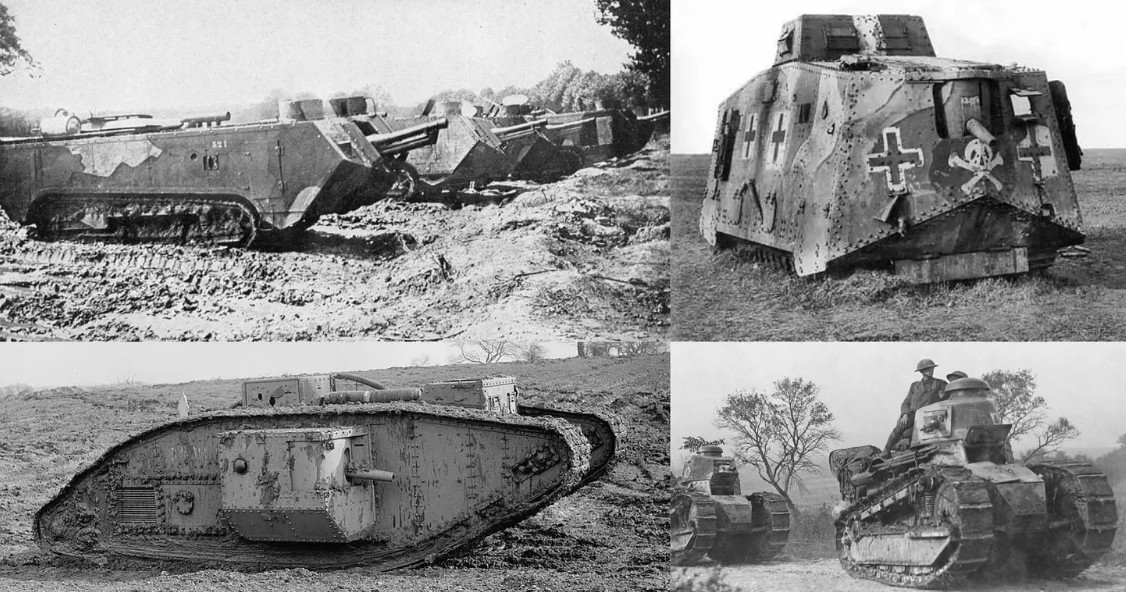
Engineering progress rarely follows a straight path. The Hardware FYI article explores several examples that demonstrate how innovation often begins with multiple competing ideas before converging on an effective solution. World War I tank development illustrates this pattern. Britain, Germany, and France each pursued radically different designs before experience on the battlefield revealed which concepts worked best. The lesson is that early experimentation matters more than perfect planning because real-world testing exposes tradeoffs that theory alone cannot predict.
A similar process is unfolding in the Ukraine–Russia war, where drone technology is evolving at remarkable speed. Engineers are experimenting with fiber-optic first-person-view drones, fixed-wing motherships, quadcopters, and other designs. The rapid pace of development is driven by economic reality. A drone costing around $1,000 can destroy a tank worth millions, fundamentally changing the cost equation of modern warfare and forcing military planners to rethink traditional armored vehicles.
The article also highlights Apple’s use of smartphone sensors to reduce motion sickness. By using the built-in accelerometers and gyroscopes, Vehicle Motion Cues create subtle animated dots around the edge of the display that move with the vehicle. The technology demonstrates that existing hardware can produce new user experiences when paired with thoughtful software design, even if the necessary sensors have existed for years.
History provides another reminder that engineering does not always depend on advanced mathematics. Builders of Paris’ Sainte-Chapelle Cathedral relied on centuries of practical knowledge, ropes, and simple geometric techniques to create stable structures long before formal engineering science existed. Practical experience often preceded scientific understanding.
The article also discusses Reflect Orbital’s Eärendil-1 project, which plans to use giant Mylar mirrors in orbit to reflect sunlight onto solar farms and other locations. Inspired by Russia’s Znamya experiments in the 1990s, the concept has become more practical as launch costs have fallen dramatically, opening new opportunities for commercial space ventures.
Finally, the article examines Blake Courter’s Moat Map, which catalogs more than 200 AI-focused engineering software companies. The growing ecosystem raises an important question for the industry: whether artificial intelligence will expand engineering software markets or disrupt the companies that have dominated them for decades. Together, these examples show that engineering advances through experimentation, adaptation, and the willingness to revisit old ideas with new technologies.
