

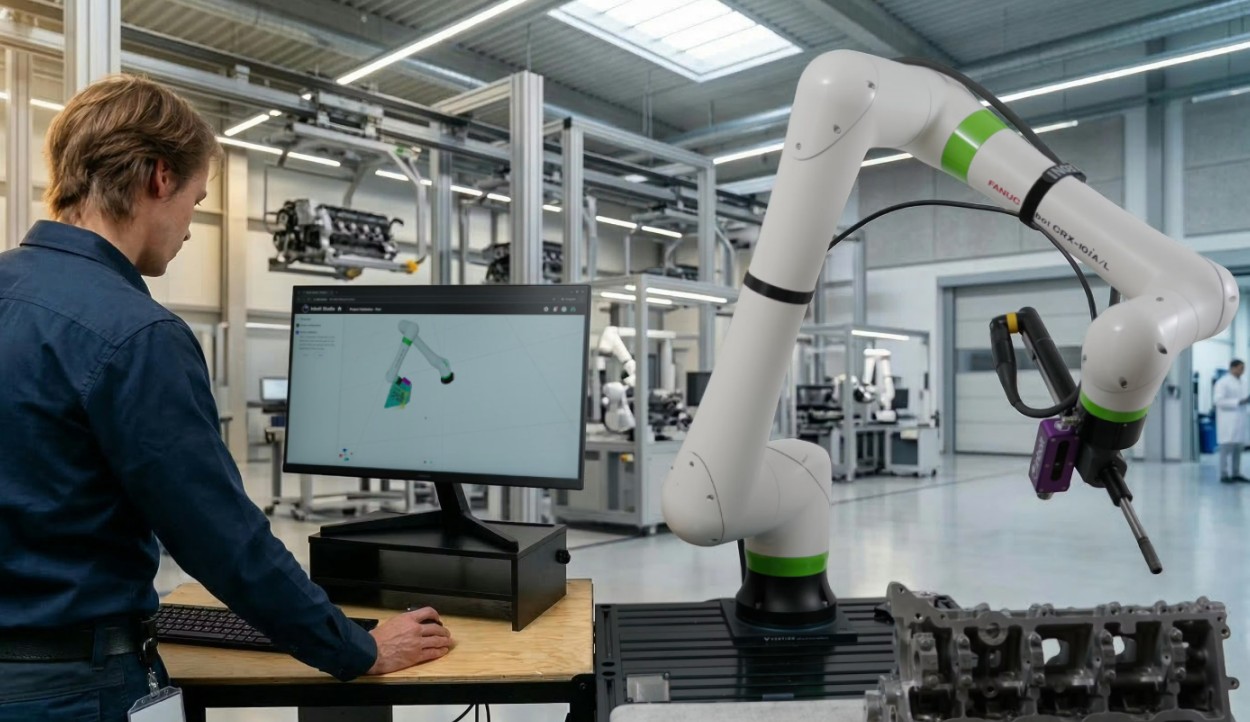
Moving a robot from a CAD model to a working production cell involves two challenges: creating a program and making it perform reliably under factory conditions. Machine Design examines how Inbolt and RoboDK address these different stages, from virtual planning to motion adjustments during operation.
Inbolt targets the mismatch between simulation and reality. Small differences in robot placement or part position can force engineers to revise trajectories after virtual commissioning. Its Robot Programming capability starts with a part’s CAD model and automatically generates a path. Runtime vision then locates the physical part and adjusts motion to follow that intended trajectory despite production variations.
According to cofounder Albane Dersy, the Inbolt Vision Model learns a part’s geometry at the edge in approximately 30 seconds to 5 minutes. The company aims to reduce repeated manual trajectory corrections. At the time of the report, Robot Programming supported FANUC, Universal Robots, and Yaskawa systems, with additional brands planned.
RoboDK concentrates on preparing and validating robot programs before deployment. Its software imports CAD files, generates toolpaths and robot motions, checks for collisions, and exports programs for different robot brands. These capabilities let engineers examine an operation digitally before committing it to equipment.
RoboDK CAM brings machining preparation into that environment, allowing users to generate paths, simulate operations, and produce robot code without requiring a separate CAM package for that workflow. The company claims deployment time reductions of up to 40%. The reported saving is a vendor claim, rather than a guaranteed result for every application or production cell.
The comparison shows why programming and operational adaptation should be evaluated separately. RoboDK helps establish what a robot should do; Inbolt uses vision to adjust execution to what is physically present. For manufacturers, both stages matter when reducing commissioning effort and moving CAD-based automation into production.
