

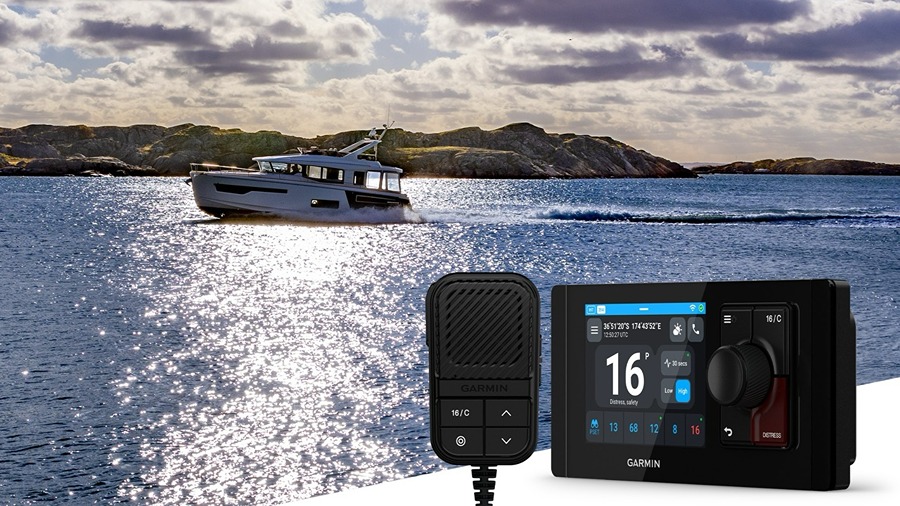
OLATHE, KA, May 29, 2026 – Garmin has released the Garmin Signal VHF 400 and VHF 220 marine radios for boaters who need VHF communication, AIS data and helm-network integration in fixed-mount units. The radios feature a 3.5-inch color touchscreen with edge-to-edge glass. The VHF 400 adds a Class B AIS (Automatic Identification System) transponder1 that sends vessel name, position, course and speed to nearby AIS-equipped vessels.
Susan Lyman, Garmin vice president of global consumer sales & marketing said: “When performance and reliability are of utmost importance, the new Garmin Signal VHF radios provide mariners with peace of mind on the water. With a compact, yet modern design, the all-in-one radios offer advanced software features to enable reliable offshore communication when boaters need it most.”
VHF Functions
- Voice communication: Automated squelch and adaptive noise cancellation reduce background radio noise during voice transmission and reception.
- VHF playback: The radios can record up to three minutes of audio from any active channel. They can record three channels at once, while advanced watch modes let captains monitor six channels for VHF activity.
- Boat-to-boat calling: A distress button uses Class D DSC (Digital Selective Calling) to send information to nearby vessels. Users can also make a DSC call to nearby vessels from the AIS plotter screen.
- Fist mic: The fist mic has a built-in speaker rated at 95 dBA at 0.5 meters. It includes adaptive background noise cancellation and can be mounted away from the head unit.
- Installation: The VHF 400 can transmit and receive VHF, DSC and AIS communication through a single VHF antenna. It also includes an integrated GPS antenna and receiver, built-in diagnostics tools and support for 12 V and 24 V electrical systems.
Remote Station
Garmin also introduced the Garmin Signal RM 100 remote station for controlling the VHF 400 or VHF 220 away from the helm. The fixed-mount head unit connects through the Garmin Marine Network and supports radio control from a secondary helm or flybridge. The intercom feature allows communication between the remote station and networked head units. The RM 100 includes a 3.5-inch color display and a fist mic that matches the Signal VHF marine radios.
System Integration
The Signal VHF radios integrate with Garmin chartplotters through the NMEA 2000 network, Garmin Marine Network 1.0 and Garmin BlueNet. They also support a compatible loudhailer for announcements, an external speaker for VHF audio at a second location and NMEA 2000 data for AIS, DSC, GPS and an external heading sensor.
Captains can configure the radio, program the Maritime Mobile Service Identity (MMSI) number and receive over-the-air software updates through the ActiveCaptain app using built-in Wi-Fi.
The Garmin Signal VHF 220 marine radio has a suggested retail price of $999.99, and the Garmin Signal RM 100 has a suggested retail price of $699.99. Both devices will be available online from June 1, 2026. The Garmin Signal VHF 400 has a suggested retail price of $1,499.99 and will be available at a later date.
1The Garmin Signal VHF 220 is AIS receive only.
Source: Garmin
About Garmin

Garmin Ltd. is a technology company founded in 1989. It designs and manufactures GPS-enabled devices and related software. Its products include smartwatches, aviation systems, marine electronics, and automotive navigation units. The company also provides applications for data tracking and device management. Garmin serves aviation, marine, automotive, outdoor, and fitness markets. Its customers include consumers, commercial operators, and government and defense users. The company operates manufacturing and distribution facilities in multiple countries. Garmin has shipped more than 285 million devices worldwide. It employs about 23,000 people globally. Its headquarters is in Olathe, Kansas.
