

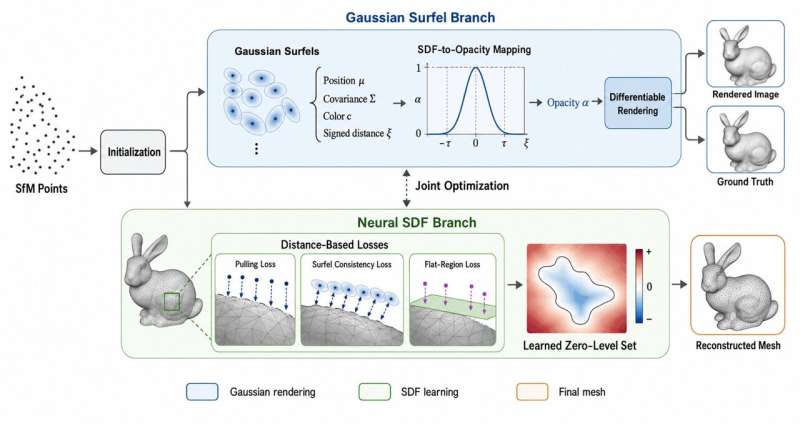
Researchers at Sejong University have developed GauSDF, a 3D reconstruction framework that combines fast rendering with accurate surface geometry. The approach addresses a persistent computer vision challenge: creating models from photographs that look realistic while also representing physical surfaces precisely, tells Tech Xplore.
Existing 3D Gaussian Splatting methods can render complex scenes in real time by representing them with collections of Gaussian primitives. While effective at reproducing visual appearance, these methods can generate blurred boundaries, floating artifacts, incomplete regions, and distorted thin structures. Signed distance functions, or SDFs, can provide more accurate geometry and support watertight mesh extraction, but their reliance on dense sampling and volumetric ray marching increases computational demands.
GauSDF combines the strengths of both techniques. It represents scenes with two-dimensional Gaussian surfels, which approximate local surface elements. Each surfel receives an independently learnable signed-distance parameter that provides information about its relationship to the reconstructed surface. A mapping function then converts these distance values into opacity, connecting geometric information with image formation.
The system uses two complementary branches. A Gaussian branch handles efficient rendering and learns properties such as position, orientation, color, scale, and opacity. A neural SDF branch learns a continuous implicit surface. Several constraints connect the branches and improve surface alignment, orientation, and spatial consistency. The resulting mesh is extracted using the Marching Cubes algorithm.
Testing produced promising results. On the DTU benchmark, GauSDF achieved a mean Chamfer Distance of 0.64 across 15 scenes, the best result among methods evaluated in the study. It also performed competitively on Mip-NeRF360 and DeepFashion3D datasets.
Challenges remain, particularly when reconstructing complex curvature and heavily occluded regions. Still, GauSDF could improve applications requiring realistic visualization and reliable geometry, including robotics, augmented and virtual reality, digital twins, cultural heritage preservation, and physical-object digitization.
