
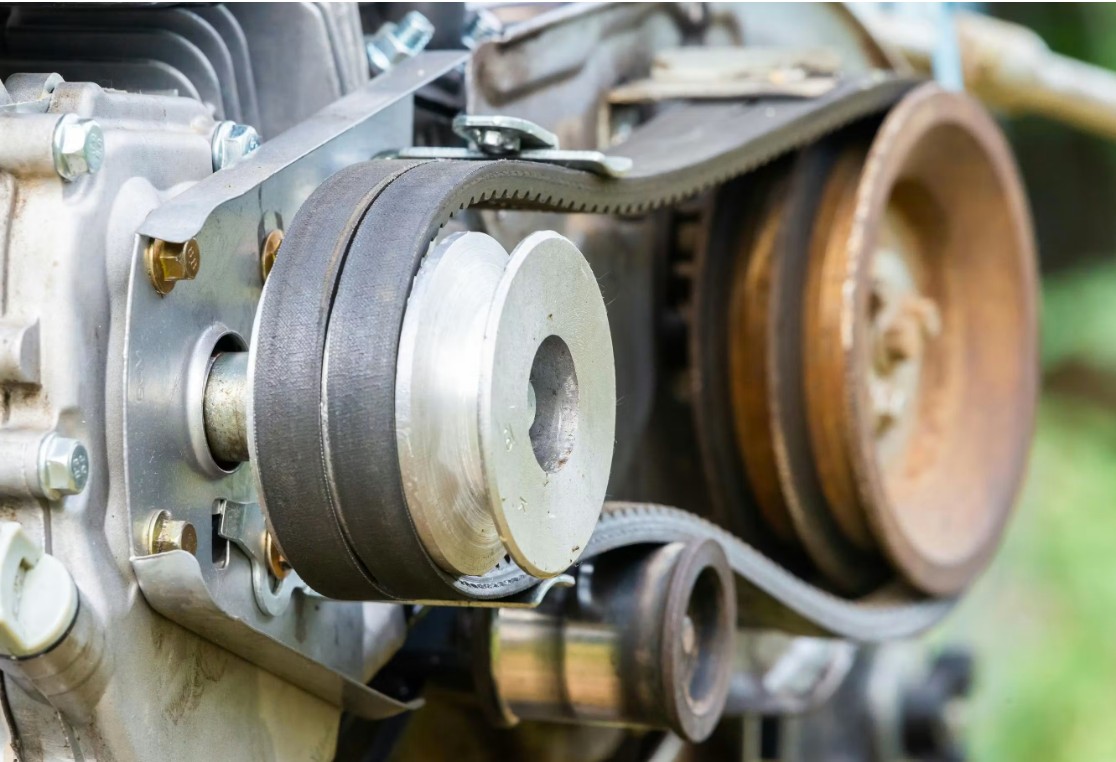
Belt drives may appear mechanically simple, but their behavior becomes considerably more complex at the speeds and precision levels required by modern automation. High-speed packaging, semiconductor handling, fulfillment systems, and other applications expose dynamic effects that conventional belt-selection methods can overlook, tells Machine Design.
At high speeds, four factors become particularly important: span resonance, tooth deformation, chordal action, and thermal pitch growth. Belt spans can resonate when tooth-mesh excitation approaches their natural frequency, creating positional jitter that servo tuning cannot eliminate. Meanwhile, elastic tooth deformation can produce micro-slip, making positioning dependent on load, speed, temperature, and belt age.
Pulley geometry also affects performance. Because a timing belt wraps around a pulley as a polygon rather than a perfect circle, its effective contact radius continually changes. Increasing the smallest pulley from 20 to 32 teeth can reduce this chordal excitation by about 60%.
Temperature introduces another challenge. A steel-cord belt operating 40°C above its calibration temperature can drift about 0.3 millimeters across a 500-millimeter span, consuming much of the positioning tolerance in precision equipment.
These effects become more significant when belts drive linked mechanisms. Four-bar and slider-crank mechanisms have position-dependent reflected inertia, which can vary substantially during a cycle. Linkage geometry can amplify belt positioning errors by two to five times at the end effector.
Instead of relying primarily on faster feedback systems, the article recommends addressing these problems geometrically. Engineers can optimize span lengths to avoid resonance, use larger pulleys, create symmetrical tension distributions, account for steady-state operating temperatures, and phase linkages so their most precise positions coincide with the belt’s most stable operating regions.
In reciprocating applications, such geometric optimization has improved positional repeatability by three to five times without changing components.
The central engineering lesson is that geometry establishes a high-speed motion system’s performance limits. Feedback and control can correct residual errors, but reliable automation begins with mechanically sound belt and linkage design.
