

MIT researchers, working with Tsinghua University, have developed GeoPT, a pretraining method that helps artificial intelligence models learn fundamental physics and simulate real-world scenarios more efficiently. The approach could help engineers evaluate vehicles, robots, and other designs while reducing their dependence on costly physical experiments and large amounts of specialized simulation data.
Conventional AI simulation models require extensive physics data generated using numerical solvers, which calculate physical properties across points on a 3D object. Although accurate, this process is computationally demanding and limits the amount of training data available. GeoPT addresses the problem through synthetic dynamics, which uses simplified interactions between small particles and complex 3D shapes to teach models basic physical behavior. The system was pretrained on 1.3 million such samples.
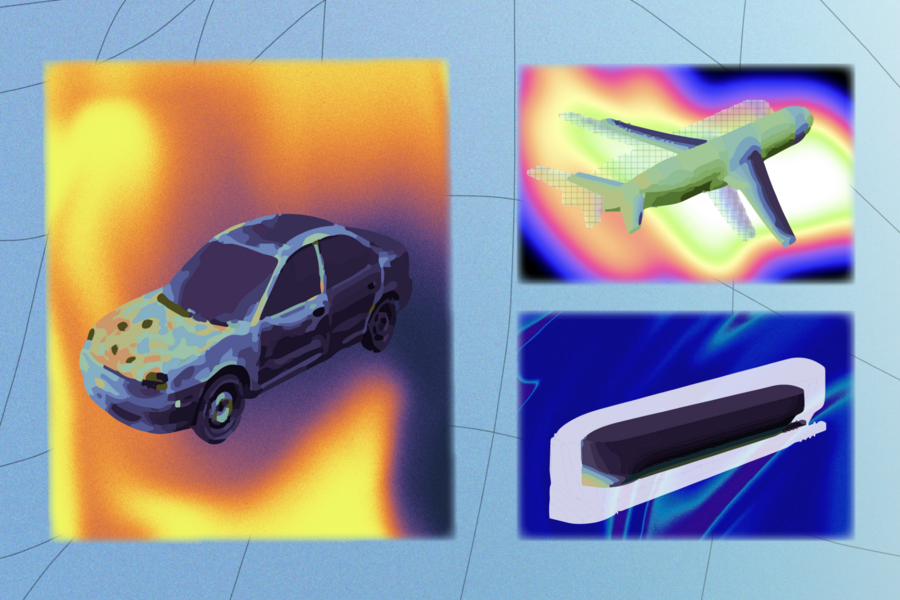
Users can upload a 3D model and specify the speed and direction of a force. GeoPT then produces a heat-map-like representation showing its effects across the object. Potential applications include predicting vehicle deformation during collisions, assessing aircraft aerodynamics, modeling light interactions, and evaluating how boats respond to air and waves.
Testing showed that GeoPT could reach peak performance twice as fast and train on up to 60% less data than leading models. In simulations involving boat hulls exposed to air and waves, it achieved peak accuracy four times faster while requiring 60% less labeled data. It also successfully predicted vehicle deformation and simulated light behavior in previously unseen geometry.
The researchers view GeoPT as an early step toward a physics foundation model that could generalize across many engineering and scientific tasks. Future versions could incorporate additional shapes and more complex phenomena, potentially supporting material testing, weather modeling, robotics, and realistic video generation.
