

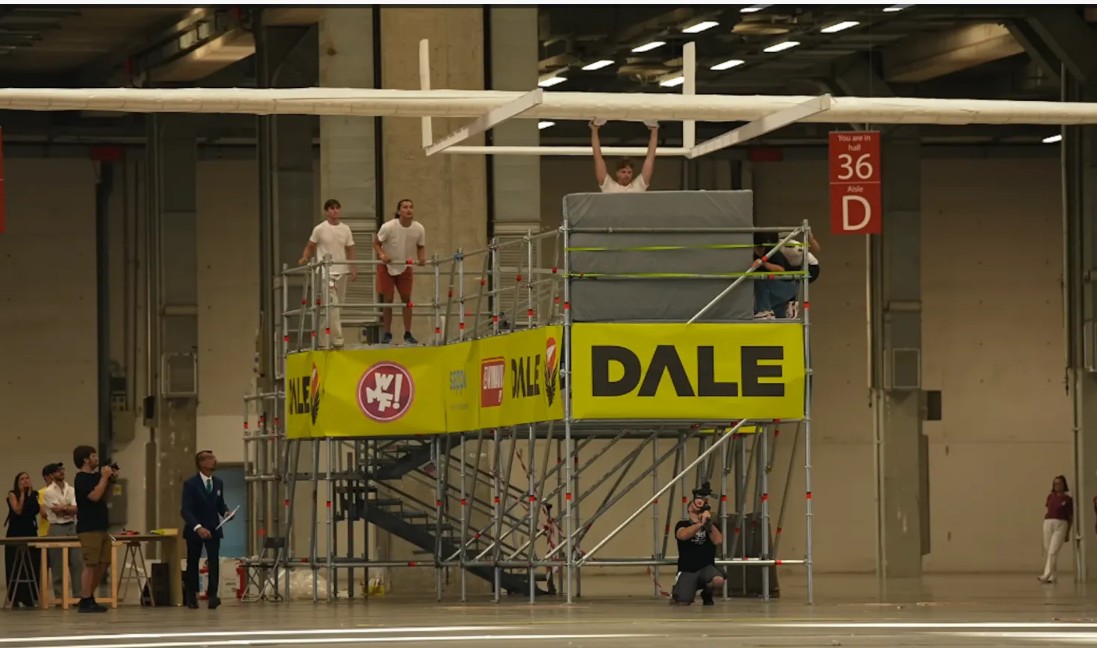
A group of aerospace engineering students from the University of Pisa has transformed one of the world’s simplest toys into a remarkable engineering achievement by building and flying the largest paper airplane ever recorded. Their aircraft, named Icarus, earned a Guinness World Record after successfully gliding nearly 200 feet during a launch at Italy’s We Make Future expo. With a wingspan of 65.75 feet (20.04 meters) and a length of more than 23 feet (7 meters), the aircraft surpassed a record that had stood since 2013, tells this Popular Science article.
Although the aircraft was made entirely from paper and glue, its design relied on the same engineering principles used in full-scale aviation. The project involved months of aerodynamic simulations, computer-aided design (CAD), structural analysis, prototype testing, and repeated refinements before the team produced a stable aircraft capable of flight. What began as a playful challenge between classmates evolved into a serious engineering exercise that demonstrated the value of combining theoretical knowledge with hands-on experimentation.
The students emphasized that the project was about more than breaking a record. By scaling up a familiar paper airplane, they encountered real aerospace challenges, including maintaining structural rigidity, minimizing weight, balancing lift and drag, and ensuring the aircraft remained stable during launch and flight. Every design decision required careful optimization because even small changes could affect aerodynamic performance.
The achievement also highlights the educational value of engineering competitions. Building a functional aircraft required collaboration across multiple disciplines, including aerodynamics, materials engineering, manufacturing, and project management. The team’s iterative design process mirrored the development cycle used in professional aerospace programs, giving students practical experience beyond the classroom.
Beyond setting a world record, Project Icarus demonstrates that engineering innovation often begins with curiosity and simple ideas. By applying rigorous design methods to an everyday object, the students showed that even a sheet of paper can become a platform for exploring advanced aerospace concepts. Their success illustrates how creativity, experimentation, and persistence can transform a childhood pastime into a meaningful demonstration of modern engineering.
