

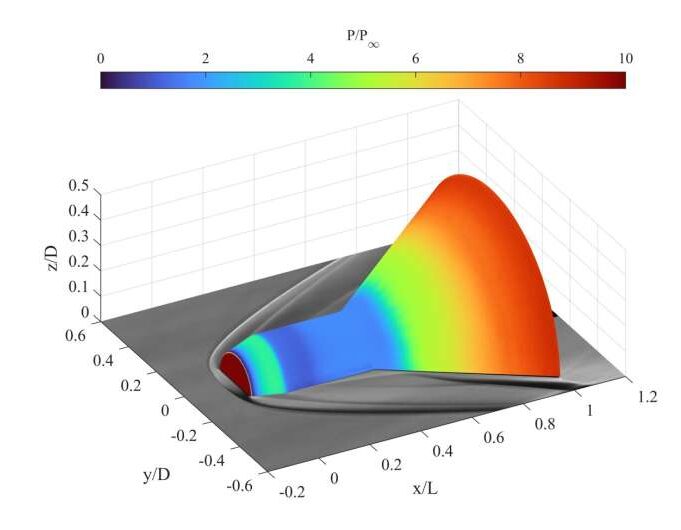
A pressure-sensitive paint developed at the University of Manchester could improve wind tunnel measurements for aircraft and spacecraft design. Engineers coat scale models with these paints and record their glow to map pressure across a surface. These maps help reveal airflow patterns that affect drag, handling, and structural loads. Existing paints also respond to temperature, however. High-speed airflow can heat a model unevenly, introducing errors into the pressure readings, tells Tech Xplore.
The Manchester team tackled that problem through chemistry. Its paint contains a light-emitting platinum-based compound anchored within a polymer similar to Teflon. Anchoring keeps the glowing molecules from clustering, which reduces their response to heat. Tests found a temperature sensitivity of 0.3% per degree Celsius, 25% lower than the industry benchmark. This makes it easier to separate changes caused by pressure from those caused by heating.
To test the material, researchers coated a cone-shaped model and placed it in a supersonic wind tunnel capable of airflow above Mach 5. The model generated flow patterns and temperature differences across its surface. Despite those conditions, the paint’s pressure measurements matched simulations. It helped reveal Görtler vortices, corkscrew-shaped swirls that form along curved surfaces and influence the thin layer of air flowing next to them.
Accurate pressure maps can help aerospace engineers check simulations and compare designs under conditions. They may expose local flow behavior that conventional measurements miss or misread. The researchers hope clearer data will support the design of safer, more efficient aircraft and spacecraft.
The work remains a research result rather than a broadly validated testing method. The team plans to evaluate the paint under a wider range of conditions to establish its reliability. Its main contribution is that modifying how the sensing molecules sit in the paint reduces a source of measurement error before engineers interpret the results.
