

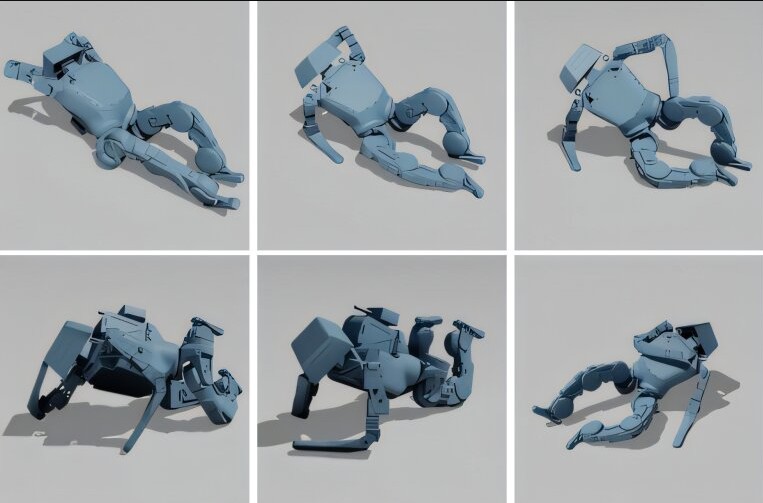
Researchers at Disney Research Zurich have taught a bipedal robot to fall in a way that’s controlled, safe, and surprisingly graceful. This Tech Xplore article details how a robot that might otherwise crash under a simple push now completes falls in predetermined, artist-designed poses while maintaining operational integrity (click here to watch the video on YouTube).
Traditional approaches to robot falls tend to focus on freezing actuators or letting things tumble uncontrolled, both risky for delicate components such as cameras or sensors. In contrast, the Disney team built a system grounded in reinforcement learning: they simulated thousands of falls in a virtual environment, rewarding the robot for minimal impact and achieving specific end poses.
The team defined 10 final poses, crafted by artists, and then subjected the robot to real-world tests (using a stick to trip it and random starting angles). Even after repeated falls, the robot emerged undamaged and consistent in its behavior. Their method combines simulation-driven policy learning with real-world execution, enabling the robot to protect its most sensitive parts regardless of fall direction.
Looking ahead, the researchers plan to expand the approach to other robot types, such as quadrupeds, and eventually enable the system to predict falls rather than just respond to them. They also want to teach the robot to recover smoothly after impact.
For engineers designing robots and automation systems, this work signals a shift: fall-dynamics, once treated as exceptional, are becoming integral to robot design. As robots move into more uncontrolled environments, soft-fall behavior may become as important as walking or grasping.
