

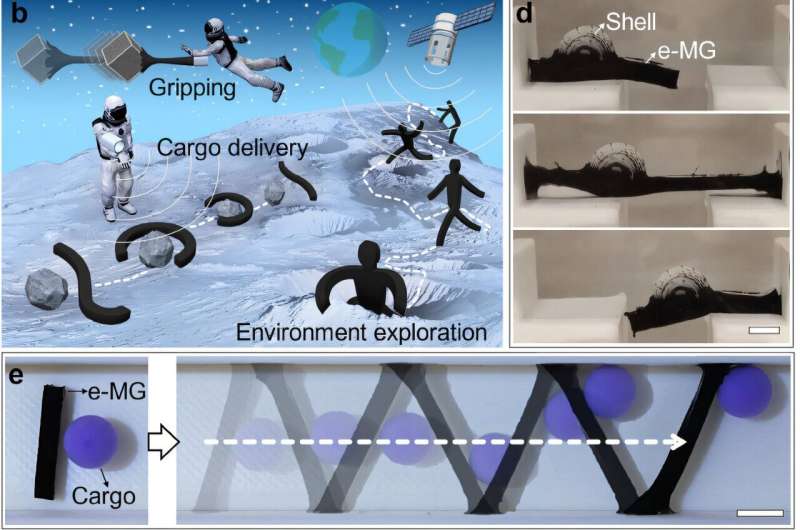
A team from the University of Bristol and Queen Mary University of London has created a soft robot using novel electro-morphing gel (e-MG) material that transforms under electric fields with large-scale deformation and agile locomotion. The work, published in Advanced Materials, marks a substantial step forward over previous soft robots that relied on heavy magnetic setups or limited actuators, tells Tech Xplore.
What makes this robot unique is its ability to morph its body dramatically, i.e., bending, stretching, and swinging from ceiling surfaces, using lightweight electrodes integrated into the e-MG composite. The researchers engineered a soft polymer composite with embedded nanocrystalline conductors so that, when exposed to designed electric fields, the robot’s body alters shape rapidly and repeats this over 10,000 actuation cycles without degradation.
The demonstration shows a “jelly-like humanoid gymnast” model that swings from a ceiling track, transitions across forms and surfaces, and even pairs with rigid robotic parts to create hybrid systems. The geometry of the robot is tailored for various scenarios, suggesting applications beyond simple soft robotics prototypes.
This innovation addresses major limitations in soft robotics: response speed, complex shape change, and durability. Traditional systems often struggled with slow actuation or bulky external fields. By contrast, the e-MG robot is self-contained, uses electric control rather than massive electromagnets, and can handle substantial morphological adaptation.
The implications are broad. Potential fields include wearable devices that adapt shape, soft robots for healthcare that fit around human bodies, and exploration systems for unstructured environments where rigid machines fail. The authors note the robot’s adaptability might make it akin to a “Swiss Army knife” of soft machines.
This research pushes shape-changing robotics into new territory by integrating advanced material science with soft robot design. It paves the way for machines that don’t just move, they transform themselves to meet the task.
