

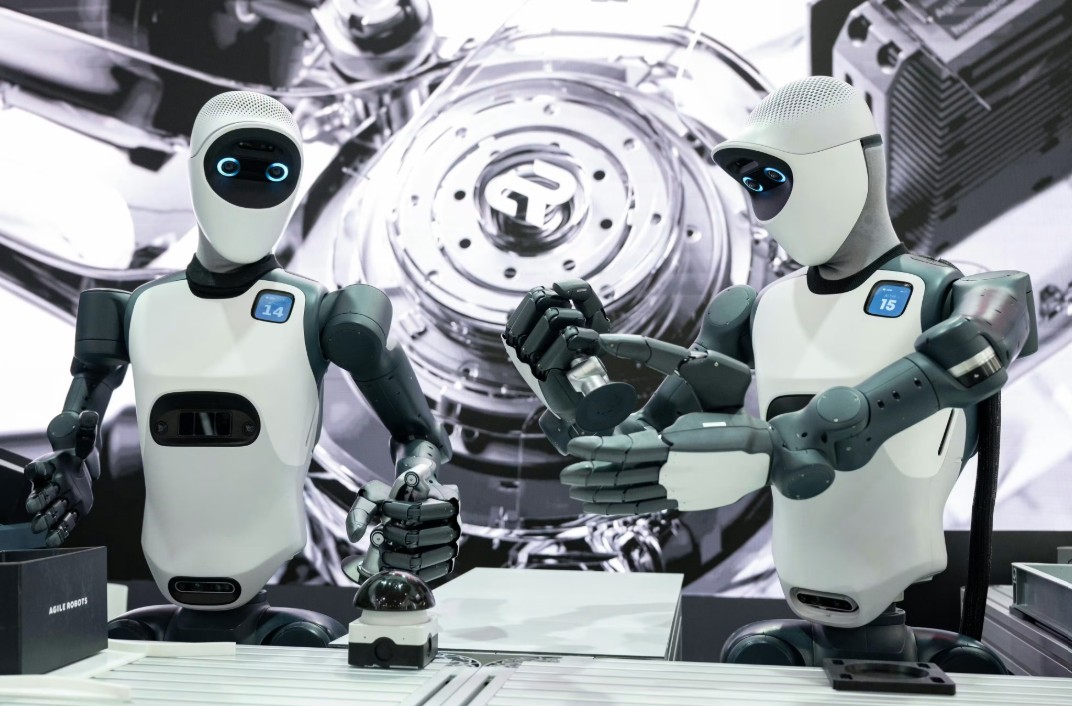
Hannover Messe 2026 signaled a shift in industrial technology from ambitious demonstrations toward practical applications delivering measurable results. Across the show, industrial AI, humanoid robots, software-defined automation, and energy technologies were increasingly presented as tools for solving factory problems rather than concepts for the future, tells Machine Design.
Artificial intelligence appears to be moving beyond isolated pilots. Manufacturers are applying AI to bottlenecks, defects, downtime, predictive maintenance, and workflow automation. Physical AI is also bringing intelligence into machines that can sense conditions and act in real time.
Humanoid robots attracted significant attention, although widespread industrial deployment remains limited. Interact Analysis forecasts more than 700,000 humanoid shipments by 2032, but many early units are expected to support testing and training. Meanwhile, a supply chain is developing around precision gears, actuators, machine-vision sensors, and batteries. China currently leads humanoid assembly, while component suppliers are distributed across Europe, North America, and Asia.
Software-defined automation represents another important transition. Functions traditionally handled by dedicated programmable logic controllers are increasingly moving to virtual PLCs running on general-purpose computing platforms. This change could reshape competition among automation hardware suppliers.
Yet advanced technologies depend on a more fundamental requirement: connecting information technology with operational technology. Factories need interoperable data, machines, sensors, controllers, and enterprise software before AI can deliver meaningful benefits. OPC UA is one approach to creating common communication across equipment from different vendors.
The show also revealed rising defense-related manufacturing opportunities, particularly across aerospace, electronics, infrastructure, and environmental-control systems. At the same time, manufacturers are favoring modernization of existing plants over expensive new facilities.
Overall, Hannover Messe showed an industrial sector becoming more pragmatic. AI, robotics, and automation are increasingly judged by production performance, integration, and economic value, with manufacturers prioritizing technologies that improve existing operations.
