

You’ve been doing it all wrong, says Brad Rothenberg during the opening keynote of the 2nd annual nTop Summit. Those are not his exact words, but what I chose to interpret from his presentation at a one-day conference that took place earlier this year in Los Angeles.
Brad is the CEO and founder of nTop, a company that leads the field of computational design. It’s no wonder: they may have invented the term “computational design.”
Over 160 nTop users have shown up for this one-day event, a big relief to nTop’s marketing, led by Andrew Hanno. The previous venue canceled only weeks before the event. The entire marketing team has had to scramble.
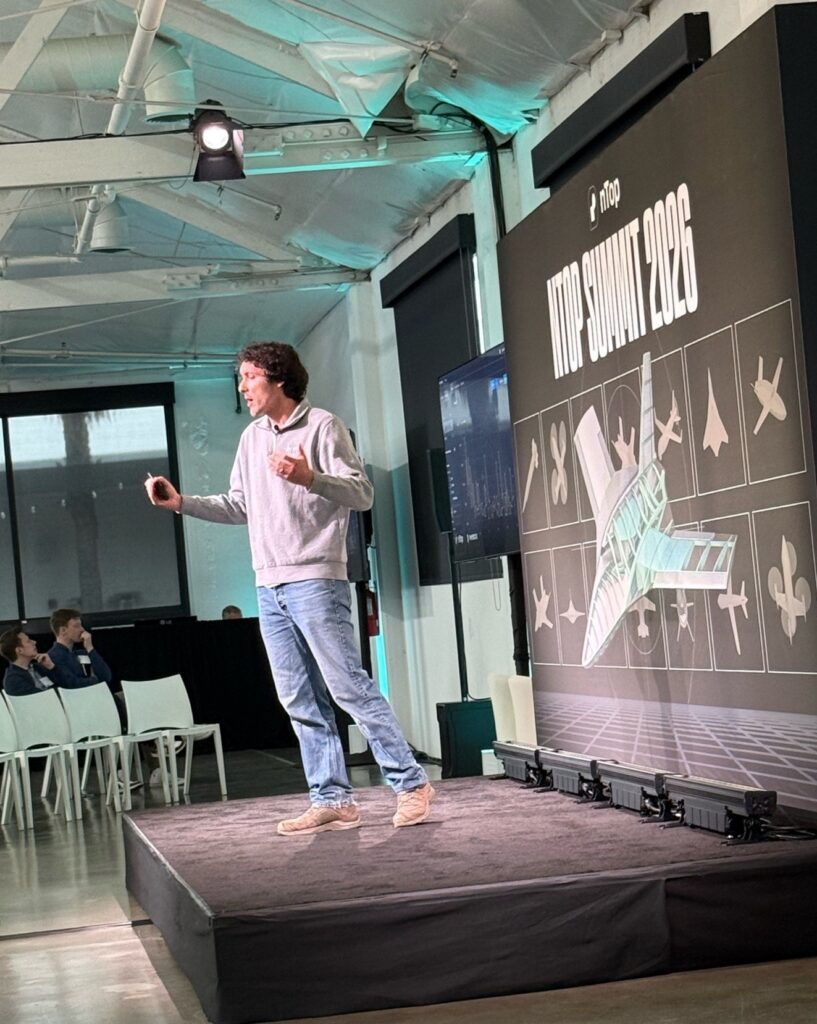
The new venue, Optimist Studio, appears to be a film studio. There may be hundreds of them in LA. The creative community is being shuffled, many displaced by AI, and I imagine there’s little trouble finding space. I read I Work in Hollywood. Everyone Who Used to Make TV Is Now Secretly Training AI about writers who can’t find work and shudder.
“It would have been more except Lockheed Martin is getting ready for its quarterly earnings call,” says Andrew.
Lockheed Martin, a big customer of nTop, is one of the companies that manufactures products or components in the LA area, which continues to be one of the centers of aerospace and aviation, housing facilities for many of the “legacy primes” Northrop Grumman, Boeing, Raytheon, plus L3Harris and relative newcomers such as SpaceX and Palmer Lucky’s Anduril.
These companies are ideal candidates for nTop and computational design. In presentations, we see turbine blades, air foils, heat exchangers — even whole aircraft (albeit drones or scale models) having their shapes optimized as only nTop can.
Last year’s nTop conference, also in LA, was maybe half the size. Could nTop’s user base be growing? Or could nTop’s marketing budget be growing? Or both? Marketing should indeed increase after a product’s technology is sufficiently mature. Also, nTop received Series D funding of $65 million in 2021. It can now afford to hold user meetings across the country (the company headquarters are in New York City).
What could be more convenient for users than having a user meeting within driving distance? That was no doubt the reason for an LA. venue. I was one of the few who flew in (from San Francisco), but most attendees were local. But as nTop grows, it might follow conventional industry wisdom: hold conferences at travel destinations, and users will fight and beg to attend. For most deskbound designers and engineers, an all-expenses-paid trip is an enormous perk. Sure beats getting out of the office only to get stuck in traffic — and LA’s traffic is among the worst in the US.
Las Vegas, sadly enough, is a favorite venue for conferences. Nashville has become popular in recent years. I would suggest San Francisco entirely for selfish reasons.
But if you consider the size of the audience a measure of the success of the software, you can’t help but wonder: “Is nTop finally catching on?”
The company that started as merely a topology optimizer, one among many, is now able to claim it is nothing less than a complete way to optimize and model.
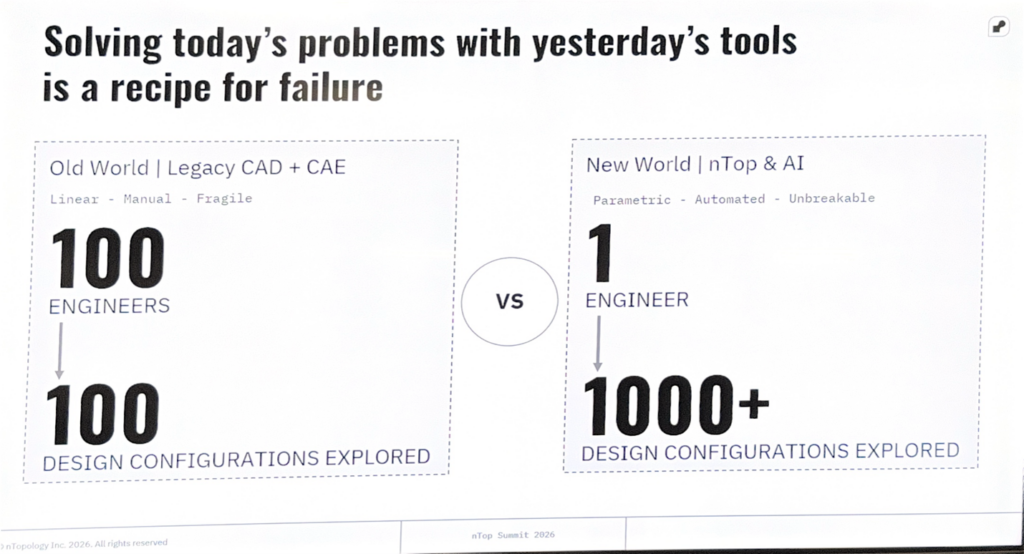
Unlike every 3D CAD program in use today, Brad’s company, nTop, uses what they call implicit modeling. Implicit models are represented with parametric equations. It’s geometry “infrastructure” rather than the geometry itself, we hear. Geometry is left to the 3D CAD modelers — and they are no good at it, according to nTop.
Implicit vs explicit modeling, as defined above, may seem like semantics to the engineer who knows 3D CAD modelers store geometry as equations, specifically 2nd order polynomials known as B-splines.
Brad would argue, however, that nTop’s equations are superior, better suited to optimization and AI. And in the age of AI, where everyone has to answer “what are you doing with AI?” what could be a better pitch?
NTop’s ability to optimize is impressive. We hear of “10,000 different design points generated in 20 minutes.”
Can your CAD system do that?, says Brad. Again, not his exact words.
The unwritten rule at software conferences is to avoid current references to potentially controversial issues, such as wars. Brad does not play by the rules. Brad plunges into the Iran/US conflict.
“In a high-intensity fight with a near-peer adversary, the US will run out of critical long-range strike weapons in under 7 days. It will take two to three years to replace them,” says Brad, quoting a CSIS analysis.
C-who, you might wonder. That’s Center for Strategic and International Studies, but Brad rattles off military acronyms and nomenclature as if he were a military analyst, not a Pratt Institute-trained architect.
“We’re using million-dollar missiles [Patriots] to destroy $15k drones [Shaheeds],” we hear. Fact check, the low-cost Shaheed drone costs $35k, according to reliable news sources [NYT].
Brad’s enthusiasm for aviation is nothing new. Last year, he told of designing aircraft as a boy and conducting aircraft design workshops at nTop. His solutions for the military, however, are more recent.
I’m reminded of Palmer Lucky, the flamboyant founder of Anduril, who is designing drones and subs for military use. Lucky taste for Hawaiian shirts and Brad’s fondness for sweatshirts may set them apart, but their belief that the US military needs a serious modernization in design, manufacturing and procurement unites them.
One of the conference sessions is a panel, “Adapting Design Workflows in the Defense Industry.”
Defense contractors are many of those in attendance. There would be more were nTop not beholden to the public cloud. The US military demands the utmost secrecy from its private contractors, so all are averse to applications that use AWS, Google Cloud or Azure.
Says an engineer from Boeing, which has a big military division, “We have our own conversational AI. We can’t have it on the cloud.”
“That is a problem,” acknowledges nTop advisor Jan van der Brand, and formerly, a technical fellow at Boeing, “and we will be addressing it.”
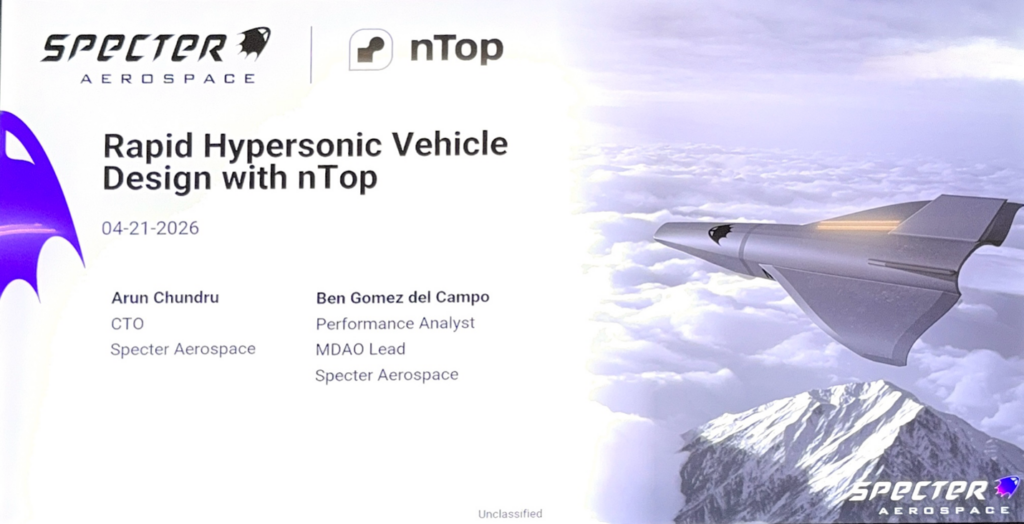
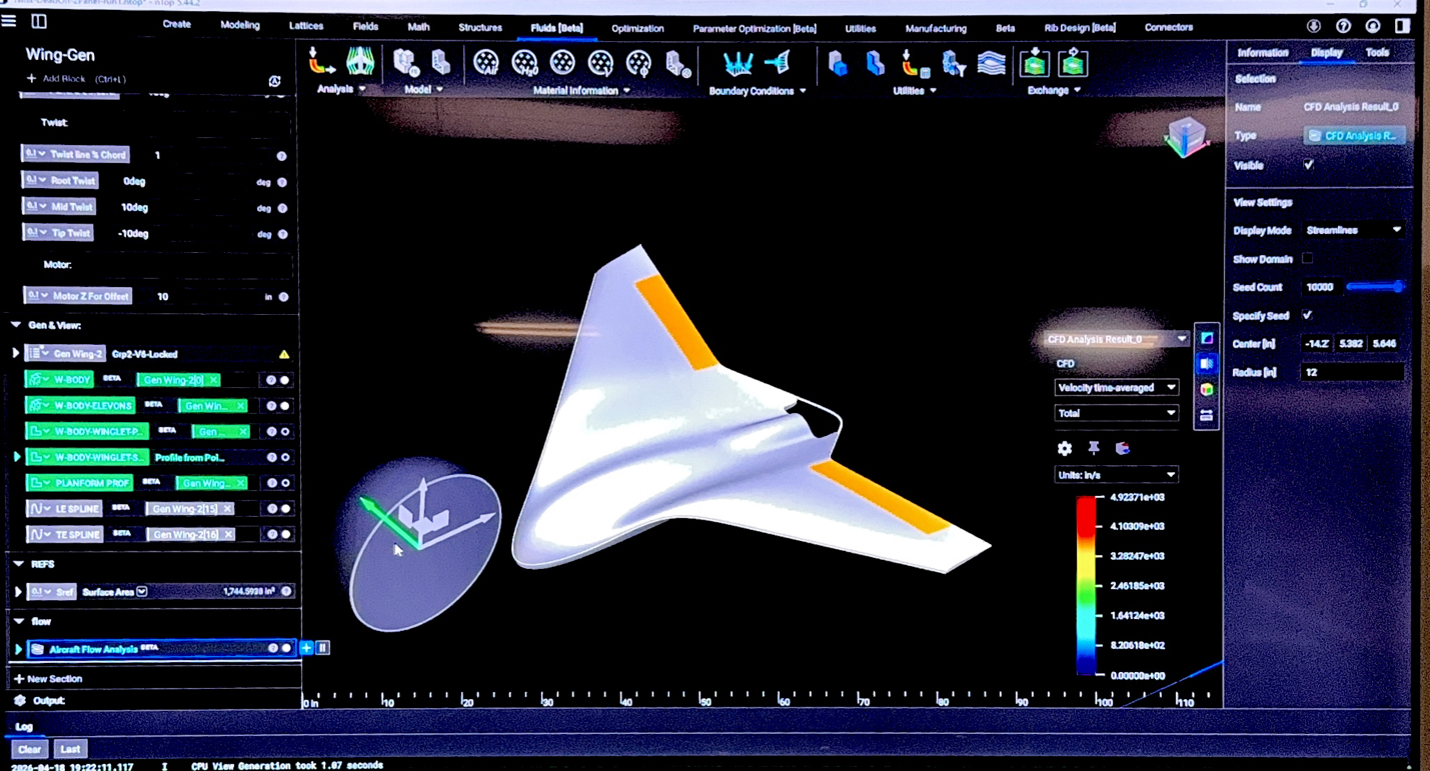
Onstage was Specter Aerospace’s CTO, Arun Chundru, warning of the “trap of modularity.” Modularity is the enemy of optimization. Not his words, but what I perceive to be his message. Modularity may be a favored principle in military hardware. Modular design allows an aircraft to take on various missions; its modules are swapped out to adapt it for different roles, such as surface attacks or air-to-air combat. Specter, in the business of hypersonic missiles, is fighting off the modularity mindset with overall mission-specific design. Having tools like nTop, presumably able to evaluate different shapes for different mission conditions (altitude, payload, range), shapes that morph the fuselage and wings rather than simply extending or shortening the fuselage, may give Specter the edge in competing for defense contracts.
We have to wonder if the massive military machine that is the US military can change in the way that new players like Anduril and nTop envision. To their dreams, Ben Gomez del Campo, an engineer at Specter Aerospace in the audience, reminds all of the reality of bureaucracy and the rules of the procurement process.
Specter addresses secrecy and public cloud issues by using nTop to design solutions similar to actual designs. Their presentations consisted of several slides that showed what appeared to be hypersonic missiles, but were accompanied by the “not the real design” caveat.
That may be fine for some purposes, but when the shape is what is being optimized, for example, for stealth, how can “similar” not expose secrets?
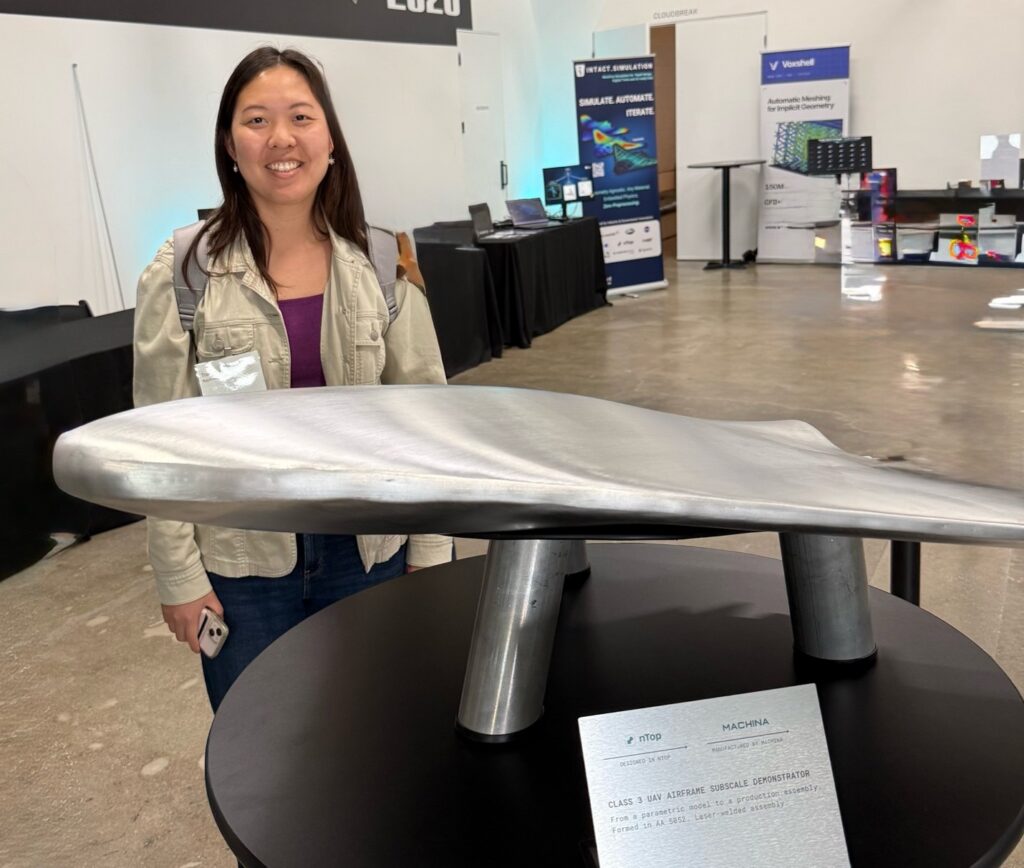
Machina Labs was on hand showing a subscale model of a UAV. It appears to be made of solid stainless steel, but it was really a 5052 aluminum alloy sheet metal laser-welded construction pounded into shape by small round hammers held by giant CNC-controlled robots, making real a shape imagined with the help of nTop. Only we can do that, says Tracy Lu, robotics process engineer at Machina Labs.
